
Wood vs. Vinyl Privacy Fence: Which Needs Less Upkeep?
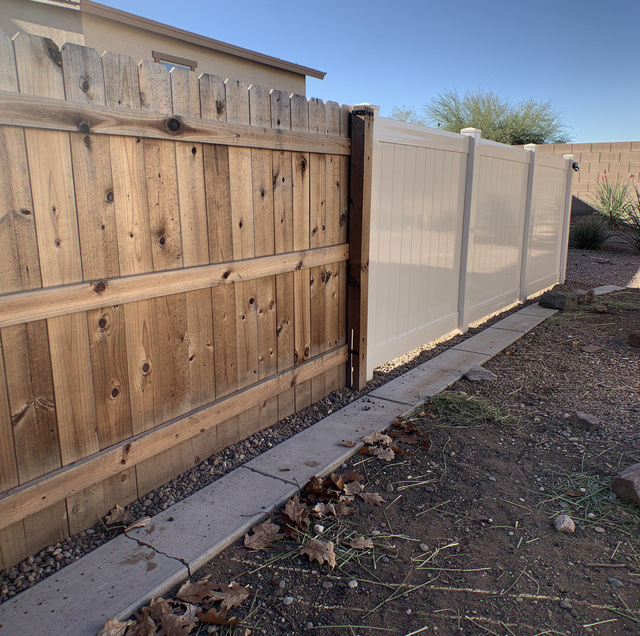
Why does a wood fence installed five years ago need a hand run over it every spring, while the vinyl fence next to it doesn't? By year five, a wood picket has usually cupped slightly, picked up a rust streak below the nail head, and gone soft right at ground level. None of that happens by accident, and none of it happens to the vinyl panel, because the two materials fail through completely different mechanisms.
What Actually Causes Maintenance Work On A Wood Fence?
Wood is hygroscopic, meaning it takes up and releases moisture with the surrounding air rather than remaining dimensionally stable. That constant exchange makes the wood expand and contract more across the grain than along it, which is the mechanism behind cupping, surface checking, and eventually splitting right at the fastener points where the wood can't move freely. End grain, especially at post tops and along the bottom few inches of a picket near the ground, wicks moisture faster than the face grain does, acting almost like a bundle of straws, which is why rot on a wood fence typically starts at the very top or the very bottom of a board rather than in the middle. Steel fasteners driven into wood that stays damp corrode over time, and the dark staining that spreads around a nail head isn't surface rust alone; it's iron reacting with tannic acid naturally present in the wood, producing that blue-black discoloration in the fibers around the fastener.
What Does A Vinyl Fence Never Need That Wood Does?
Vinyl fencing is extruded PVC, a closed-cell polymer that doesn't absorb water the way wood does, so it never needs staining, sealing, or repainting, and it can't rot or host wood-boring insects the way an untreated board can. It still collects a surface film of dirt, pollen, or mildew over time, particularly in shaded or damp corners of a yard, but that's a surface-level issue that can be solved with a hose and mild detergent rather than a coating that has to be reapplied on a schedule.
How Do The Two Materials Handle Ground Contact?
A wood post set in concrete is most vulnerable at the transition line where the concrete meets the open air, since moisture wicks up from the footing and the wood at that spot never fully dries out between wet cycles. That's where post rot typically begins, not below ground where it's often assumed to start. A vinyl post is usually a hollow shell over a galvanized steel or aluminum insert, sometimes with the cavity filled with concrete for rigidity, set into its own footing. The vinyl shell itself doesn't rot, but the metal insert inside can corrode if water gets into the sleeve without a weep hole to let it drain back out.
Wood vs Vinyl: Where The Upkeep Actually Differs
| Task | Wood Fence | Vinyl Fence |
|---|---|---|
| Refinishing | Stain or seal on a recurring cycle to slow moisture cycling | Never needed; color runs through the material itself |
| Cleaning | Occasional wash, more often in shaded or damp spots prone to mildew | Periodic rinse to clear surface film |
| Fastener check | Inspect for corroding nails or screws and rust staining | No exposed fasteners on most panel systems |
| Post-base inspection | Check for softness right at the concrete-to-air line | Check the sleeve for cracks and trapped moisture |
| Panel repair | Individual boards can be swapped one at a time | Interlocking panels usually replace as a full section |
| Handling expansion | Swells and shrinks with humidity; fasteners can work loose | Panels install with built-in expansion gaps for thermal movement |
What Installation Reveals About Long-Term Upkeep
A wood privacy fence goes up board by board or panel by panel, fastened with nails or screws driven through the face into the rails behind. Every one of those fastener points is a future maintenance check, since each one is a spot where water can work its way in around the shank over time. A vinyl privacy fence assembles differently: panels click into routed channels in the posts, with far fewer exposed fasteners overall, which is part of why vinyl's ongoing task list stays so short. The trade-off shows up when something needs replacing rather than during routine care: swapping one wood picket is a five-minute job with a hammer or drill, while a cracked vinyl panel section often has to be worked free from the channels on both sides, which sometimes means loosening the neighboring panel as well. That's worth factoring into how a repair gets scheduled: a wood picket swap can happen any time without planning around the panels on either side, while a vinyl section replacement is easier to plan for a calm day with no wind pressing against the adjoining panels while they're briefly unsecured.
How Sun And Shade Change The Maintenance Picture
A fence line that gets full sun most of the day ages differently than one that sits mostly in shade, and that holds for both materials, just through different mechanisms. A shaded wood fence section stays damp longer after rain or irrigation, which is exactly the condition that favors mildew growth and slows the wood's ability to dry out between wet cycles. A shaded vinyl section collects the same surface film more quickly because it doesn't get the same periodic sun exposure that helps burn off moisture and organic buildup on a sunnier stretch of fence. Neither material avoids the shade problem entirely; wood's version manifests as a health issue for the wood fibers themselves, while vinyl's version remains cosmetic. That's a useful distinction when deciding how often to check a shaded run specifically: a shaded wood section is worth a closer inspection for soft spots or active mildew, while a shaded vinyl section needs a wash more often than a sunnier stretch of the same fence would.
Where A Repair Decision Gets More Complicated
A single damaged wood picket is almost always worth fixing on its own, since the fix is isolated to that one board and doesn't disturb anything around it. A damaged vinyl panel section raises a different question: because panels interlock, a technician sometimes has to weigh whether replacing just the damaged section leaves a visible mismatch if the surrounding panels have faded slightly with age, since vinyl color is baked through the material and won't touch up the way a wood stain can blend an old and new board together.
Which One Actually Saves Time Over A Decade?
Wood asks for small, recurring attention: a stain cycle here, an occasional board swap there, spread out over years. Vinyl asks for almost nothing on that same recurring basis, but it's less forgiving of a hard impact, since a cracked panel section more often requires full replacement rather than a board-level patch, as a single damaged wood picket does. The real difference isn't which material is better outright; it's whether the owner would rather handle small, predictable maintenance on a schedule or effectively none until something breaks outright and needs a section-level fix.
What Hardware Choices Change For Either Material
The fasteners and hardware holding a fence together age on their own timeline, separate from the fence panels themselves. On a wood fence, upgrading from standard galvanized nails to stainless steel or ceramic-coated deck screws during a repair reduces the corrosion-driven staining described earlier, since those coatings resist the reaction with tannic acid that plain steel doesn't. Hinges and gate hardware on a wood fence face the same corrosion exposure as the picket fasteners, so a gate that's starting to sag is worth checking for rusted hinge pins before assuming the post itself has shifted. On a vinyl fence, the hardware that matters most is at the gate rather than along the fence line itself: hinges and latches mounted to a post that has to stay rigid enough to keep the gate hanging square, which is exactly why gate posts get that internal metal reinforcement mentioned above even on an otherwise all-vinyl fence.
Frequently Asked Questions
Yes, on a standard board-on-board or dog-ear picket fence, each picket is fastened independently, so a single damaged board can be pulled and swapped without touching the rest of the section, a repair option most vinyl panel systems don't offer since their panels interlock as a unit.
PVC does stiffen as temperatures drop and becomes more prone to cracking under a direct impact in cold conditions, which matters less in a climate that rarely sees a hard freeze but is worth knowing if a panel takes a solid hit during an unusually cold stretch.
It's a chemical reaction between iron in the fastener and tannic acid naturally present in the wood, not plain surface rust. The staining itself is cosmetic and doesn't automatically mean the wood underneath is decaying, but a fastener reacting enough to stain the surrounding grain is also corroding its own grip, so a heavily stained nail or screw is worth checking for wobble even where the wood around it still looks sound.
Taller vinyl panels and gate posts commonly have a steel or aluminum insert set inside the vinyl post sleeve for added rigidity, since PVC alone flexes too much to support gate hardware or resist wind loads at greater heights.
No: pressure treatment protects the wood's interior from rot-causing fungi but doesn't stop the surface from absorbing and releasing moisture, so cupping, checking, and fastener corrosion still occur on treated lumber, just without the decay risk that untreated wood carries.
Rarely: vinyl panel systems are engineered around their own specific post spacing and sleeve dimensions, so converting from wood typically means new posts and footings rather than reusing the wood fence's existing post layout, even where the fence line itself stays the same.
Yes: darker, semi-transparent stains fade unevenly and often need reapplication sooner to look consistent, while a solid-color stain or paint hides UV fading longer but eventually requires scraping or sanding before recoating, rather than a simple re-stain over the existing layer.
Wood spreads its maintenance out in small doses: a stain cycle here, a swapped picket there, across every year it stands. Vinyl skips almost all of that same routine and instead defers it until a cracked panel calls in everything it postponed, all at once. That's less a question of which material lasts longer and more a question of which maintenance rhythm actually fits the property.
Get a privacy fence recommendation based on how much upkeep actually fits your routine — a technician can walk through wood and vinyl options on-site. Sereno Custom Fence & Gates serves Phoenix and the Valley. Call (602) 353-7385.
