
Swing Gate vs. Sliding Gate: Which Fits a Driveway?
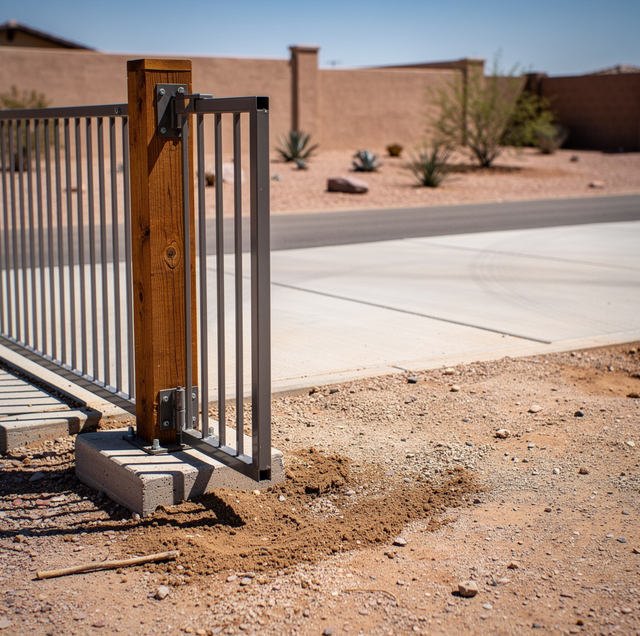
A swing gate needs open ground to sweep through. A sliding gate needs open ground to slide past. The two requirements sound interchangeable until an actual driveway gets measured, and on a narrow or sloped lot, one of them usually gets ruled out before the other design questions even come up.
How a Swing Gate Actually Opens
A swing gate pivots on hinges bolted to a post set in a concrete footing. That footing carries a cantilevered load every time the gate moves: the full weight of the leaf hanging off one edge, transmitted through the hinges into the post and down into the concrete. Footing depth and diameter scale with the gate's height and weight for that reason. The leaf then travels through an arc equal to its own length, and that arc needs to be clear ground, on one side or both, with no grade change steep enough to catch the bottom edge partway through the swing.
How a Sliding Gate Actually Opens
A sliding gate moves parallel to the fence line instead of through an arc. A cantilever slide gate rides on rollers mounted inside a rigid steel frame that extends past the opening at both ends, counterbalanced on two or more support posts sunk into footings sized to resist the tipping force of the overhung frame. The gate never touches the ground and needs no track. A track-mounted slide gate, by contrast, runs on wheels along a ground-set track that must remain level and free of debris for the full length the gate travels.
Four Questions That Decide It Before Preference Does
Does the driveway slope where the gate needs to travel? A swing gate tolerates a modest grade at the opening since only the hinge geometry has to clear it. A cantilever slide gate requires a level run for its entire travel distance, as the frame rides on rollers set at a fixed height.
Is there open ground beside the opening equal to the driveway's width? That's where a sliding gate has to go once it's open. A retaining wall, dense landscaping, or a slope immediately beside the opening can rule out sliding out regardless of how much room exists in front of the gate.
Is there room for the swing arc, both directions? A leaf can swing in, out, or split its travel both ways, and each option needs its own clear paved or graded space, front, back, or both.
What's the total load, and is it one leaf or two? A double swing gate splits both the arc and the cantilevered weight across two hinge posts instead of one, which sometimes makes a wide opening workable on a site too tight for a single long leaf.
Swing vs Sliding: Side-by-Side Comparison
| Factor | Swing Gate | Sliding Gate |
|---|---|---|
| Ground clearance needed | Clear arc equal to leaf length, one or both sides | Clear level run beside the opening equal to gate width, plus overhang for a cantilever frame |
| Slope tolerance | Handles a mild grade at the opening | Needs a level track or cantilever run |
| Footing demands | Hinge post footing sized for the cantilevered swing load | Support posts sized to resist the tipping force of an overhung frame |
| Automation type | Swing arm or underground operator, arc-based travel | Gear-and-rack operator, straight-line travel |
| Debris exposure | Wear shows up first at the hinge pivot | Rollers and track collect windblown debris along the full run |
| Typical material fit | Wood, iron, aluminum, tubular steel | Iron, aluminum, or steel; cantilever frames need internal rigidity |
| Site prep before footings are poured | Verify arc clearance on both sides at the exact gate height, not just at the ground | Verify the full slide run is level and confirm nothing underground blocks the support post footings |
What Installation Actually Involves For Each Type
Site prep starts differently for each type, and the order of operations matters. A swing gate installation centers on the hinge posts. Those posts get set first, plumbed precisely, since even a small lean throws off how the leaf hangs and closes; then the footing cures before the hardware goes on and the gate takes its full weight. A sliding gate installation centers on the run instead of a single post pair: the ground along the travel path gets graded level, support posts for a cantilever frame go in at measured intervals to carry the tipping load, and the gate frame itself, which extends well past the visible opening on a cantilever system, needs enough overhang past the last support post to counterbalance properly. That overhang is often the detail a driveway with limited side yard runs out of room for first, before the visible opening itself becomes the constraint.
How Each Gate Type Handles Wind Load
A swing gate leaf acts like a sail every time it's open partway, catching crosswind on its full face with nothing to brace it except the hinges and the ground clearance beneath it; a gust hitting a gate mid-swing puts a twisting load through the hinge post that a properly sized footing is built to absorb, but an undersized one will loosen over repeated gusts. A sliding gate, once closed, presents the same flat face to wind as a swing gate does, but while it's in motion it stays supported along its rollers or its cantilever frame the entire time, so it doesn't swing loose the way an open swing leaf can if a gust catches it mid-arc. That difference matters most on an exposed site with few windbreaks nearby, where a gate spends real time partway open during a slow automated cycle. Material adds another layer to this: a solid infill panel, whether wood or a paneled iron design, catches more wind than an open picket pattern does, so a solid-panel swing gate on an exposed lot needs a heavier hinge post and footing than a picket-style gate of the same size.
When the Site Could Support Either Type
Some driveways truly have room for both, level ground on one side and enough swing clearance on the other. At that point, the deciding factor usually isn't the gate itself but what sits along the fence line: a sliding gate needs that side yard to stay clear permanently, so a section that might later hold a shed, a parked trailer, or new landscaping works against a slide gate's future, even if it works today. A swing gate's arc, once the gate is closed, gives that same side yard back for anything else, since the space is only needed while the gate is actually in motion. That's worth weighing even if a shed or storage plan is years off rather than immediate, since moving a sliding gate's support posts later means new footings, not just relocating a hinge.
Automation Differences Worth Knowing Before You Commit
A swing arm operator mounts directly to the post and the gate leaf, pushing the gate through its arc, making it a fairly simple retrofit for an existing swing gate that wasn't originally automated. A slide operator engages a rack bolted to the gate's bottom rail with a drive gear, so retrofitting an older sliding gate for automation means confirming or adding a rack-compatible bottom rail first; a gate built without one can't simply have an operator bolted on.
Long-Term Maintenance Differences
Wear on a swing gate shows up first at two points: the hinges, which carry the full cantilevered load on every cycle, and the latch, which absorbs the impact of the leaf closing. Wear on a sliding gate shows up first at the rollers and track, where fine dust and grit get pressed into the wheel bearings over repeated cycles, so a sliding gate's track needs a periodic sweep that a swing gate's arc never requires. A swing gate's hinges can be adjusted or replaced individually without touching the rest of the structure. A sliding gate's rollers sit inside the frame itself, so a worn roller assembly is more often a shop repair than a five-minute field fix. A latch or hinge pin swap on a swing gate is the kind of repair that can happen with the gate still hanging in place; a roller replacement on a cantilever slide gate more often means lifting the frame off its support posts entirely, since the rollers are set inside the frame's internal channel rather than bolted on from outside.
Frequently Asked Questions
Sometimes, if the existing posts can be reset deeper to carry the overhung load, but cantilever frames also need internal bracing that a simple track-mounted gate wasn't built with, so this is usually closer to a new gate than a modification of the old one.
Generally yes: splitting the width across two leaves roughly halves the cantilevered load each hinge post carries, which is why a double swing gate on a wide opening can use shallower footings than a single leaf spanning that same width would need.
Grit that works into the roller bearings can cause the gate to bind or drift off-track over repeated cycles, so the track itself needs a sweep after a heavy debris event, not just a wipe-down of the visible rollers.
A swing gate's leaf covers ground on the inside of its arc while moving, which matters where that side is a play area or a spot pets tend to gather, while a sliding gate's leaf stays confined to the fence line for its entire travel.
Rarely without new posts: sliding gate posts resist a tipping force from an overhung frame, a different load path than a swing gate's hinge post handles, so this conversion is closer to a full gate replacement than an upgrade to the existing structure.
A single sliding leaf can span a wide opening without any center support, whereas a wide swing opening often requires two leaves to meet in the middle, adding a second hinge post, a center gate stop, and a latch mechanism.
A swing gate and a sliding gate solve the same problem with opposite floor plans; one borrows space it swings over, the other borrows space it slides past. Whichever floor plan the driveway actually has room for is the one that works, regardless of which style appears more often in photos.
Get a site visit to confirm which gate type actually fits your driveway — a technician checks the slope, clearance, and footing conditions before recommending a swing or slide gate. Sereno Custom Fence & Gates serves Phoenix and the Valley. Call (602) 353-7385.
