
Does Vinyl Fencing Warp in Extreme Heat? Movement vs. Damage
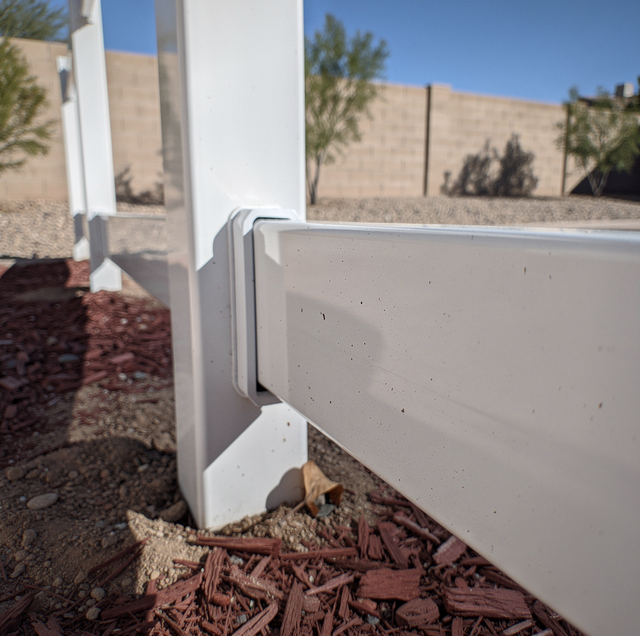
PVC expands when heated and contracts when cooled. That is a property of the material, and every brand of vinyl fence does it. A rail measures slightly longer by mid-afternoon than it did at first light, gives that length back overnight, and repeats the cycle for the life of the fence. A well-built vinyl fence is engineered around that behavior, with parts assembled so the movement has somewhere to go. The useful question is where the line falls between movement the system was designed to absorb and movement that has crossed into damage. Those two have different causes, and only the second calls for a repair.
Quick Answer: Vinyl fencing expands and contracts with temperature, and a well-built system absorbs that movement without distortion. Visible distortion traces to a short list: rails fastened rigid, bays too long for the rail, posts that have shifted, or concentrated heat on one spot.
How Thermal Expansion Works in a PVC Fence System
Rigid PVC changes dimensions with temperature more than steel, aluminum, or wood beside it. The change is invisible on a short piece and adds up on a long one, so movement shows in rails first: a rail between two posts is the fence's longest continuous piece of vinyl.
Rails float inside the post routs: Each post is routed with rectangular openings, and the rail ends slide into those pockets with clearance at each end, so a rail can lengthen and shorten along its own axis without pressing on anything. Pickets drop into slots in the rails and are held by rail geometry and locking tabs, so they move, too.
Clearance where the run ends: Where a fence line dies into a house wall or masonry column, butting the last post tight leaves the growth nowhere to travel, so it gets pushed back into the panels.
A pinned rail has to put the length somewhere: Drive a screw through the post into the rail end, and that end is locked. The rail still expands, and since it can no longer lengthen, the extra dimension causes it to bow out of plane. Daily cycling then works the fastener, the hole elongates, and hairline cracks radiate from the screw. Pinned rails are a common reason a fence looks wavy, even when the vinyl is sound.
The Real Causes of Sagging Rails and Warped Pickets
Sagging and warping are often used interchangeably, but they are distinct failures with separate causes, and telling them apart points to the right fix.
Sagging is a rail deflecting downward across its span. The bottom rail of a tall privacy panel carries every picket sitting in it, and vinyl loses stiffness as it warms, so a long span with nothing inside it bows at mid-span and settles lower each cycle. A rail built for that duty carries an internal stiffener, an aluminum or galvanized steel channel run the length of the hollow rail, which takes the bending load. Sagging in the longest bays is a span-and-reinforcement problem before it is a heat problem.
Warping is deformation out of plane: a picket that bows away from its neighbors, twists, or develops a shallow dish. It shows up where heat meets restraint, or where one small area takes far more heat than the rest. A picket free to move handles heat on its own.
Posts feed their own movement into the panel: A post set shallow or backfilled with loose material shifts under load, and that shift racks the panel it holds, which reads as a wavy section and gets blamed on the sun. Once the post is reset and holds, the panel can square back up, provided the vinyl has not taken a set of its own.
Reflected Heat, Dark Colors, and Hot Spots
Surface temperature is the number that matters, and it runs well ahead of the air. A dark rail in direct sunlight sits far above the surrounding air because dark pigment absorbs more of the solar spectrum and converts it into heat within the profile wall. White vinyl reflects much of that energy and stays closer to ambient.
Three conditions concentrate heat further.
Reflective glazing: Energy-efficient window glass reflects much of the solar spectrum, and a pane that flexes slightly becomes a shallow mirror, focusing sunlight into a narrow band that tracks across whatever lies opposite. Where that band lands on vinyl for a few hours a day, the surface reaches temperatures the profile was never built to hold, and the signature is a glossy, slumped, or scalloped area on one or two pickets at a consistent height, with the panels on either side untouched.
Water and pale hardscape: A pool surface, light decking, or bare concrete throws radiation back up, so the bottom rail and lower pickets take a second dose from below.
Masonry: A block or stucco wall absorbs heat all day and releases it long after the sun moves off. Vinyl running close and parallel to it is loaded from both sides, with little air in between, and stays hot even after an open run has cooled.
UV Stabilizers, Impact Modifiers, and the Chalking Problem
A vinyl fence profile is more than PVC resin. Titanium dioxide does double duty as the white pigment and as a UV blocker, scattering radiation before it reaches the polymer chains. Stabilizers protect the resin during extrusion and keep it working in service, and impact modifiers, commonly acrylic, prevent the profile from shattering when a ball or mower deck hits it. That package slows photodegradation and holds color.
What it does not do is change the physics behind warping. UV stabilizers and impact modifiers leave expansion per degree and the softening point close to those of the base resin, so the package mainly governs how the surface survives exposure, while geometry and installation govern whether the panel stays flat.
Chalking and brittleness are different failures: As the surface weathers, the binder at the face erodes and leaves loose titanium dioxide behind, a fine white powder that comes off on your hand and dulls the color. Deeper in, long UV exposure costs the material some flexibility, so a panel that once flexed under a knock can crack instead. Both are age-and-exposure conditions, and shape is a separate question: one fence can be chalky and dead straight, another glossy and badly bowed. On PVC, chalking reports surface age while bowing reports heat and restraint.
Installation Choices That Prevent Heat Distortion
Post spacing is dictated by the rail. Each profile and height has a maximum on-center spacing, and stretching a bay past it to save a post is the surest way to build in a sagging bottom rail. Reinforcement follows height and span: tall privacy panels and wide bays need the stiffened bottom rail.
Rails get held by the system's own locking hardware, which keeps them seated while allowing lengthwise travel. Through-fastening a rail end into a post quiets a rattle and can buy a bow.
Color gets chosen against exposure: white and light tan on the runs taking the hardest sun, darker colors on shaded runs, a choice that is hard to undo once the fence is up.
Position gets chosen against reflection. Where a run passes a window wall, a pool, or hot masonry, slightly offsetting the line or placing a post at the hot spot keeps a concentrated band off a long picket. And posts get set to a proper depth in compacted backfill, so the panel is never fighting a footing that moves.
Before choosing a dark vinyl color, walk the fence line in mid-afternoon and note where sunlight bounces off windows, water, or pale masonry. Those bright strips mark the places a panel is most likely to distort.
What Can Be Corrected and What Has to Be Replaced
A plastic patio chair that has spent years outside shows what permanent set looks like. The legs splay wider than they did new, the seat carries a shallow dip, and it stays that way when it cools, because the polymer relaxed under sustained load and heat and re-formed around the new shape. Vinyl fence parts do the same, and the dividing line for any warped piece is whether it has reached that point.
Correctable in most cases: a through-fastened rail that has begun to bow but has not set, since releasing the restraint lets it travel again, and the bow often relaxes. A panel racked by a moving post, which squares back up once the post is stable. Chalking, a surface condition that washes back to a duller version of the color.
Replacement territory: any rail or picket still visibly out of line in the coolest part of the day after its post is solid and any through-fastener is released, which is the test for permanent set. A glossy melted or scalloped patch from reflected glare, since that material has flowed and will not flow back. Cracks radiating from a fastener hole or along a rail. Panels on a run where bay spacing exceeded what the rail can carry, since a new rail in an oversized bay repeats the same sag.
Telling Normal Movement From a Failed Panel
Do the reading early in the day, before the sun has been on the fence long. The material is at its most contracted then, and anything still out of line at that hour is not daily expansion: it is a set in the vinyl, or a pinned rail or shifted post still acting on it.
Sight down the fence from one end with your eye close to the rail line. Normal movement is invisible at that scale: the line reads straight, picket faces sit flush with their neighbors, and a full day of expansion leaves nothing a homeowner can see, since the travel happens at the rail ends concealed inside the post pockets.
A failed panel announces itself. A rail holds a visible bow at first light. A picket has rotated far enough that its face no longer lines up with its neighbors, or it has pulled partway out of the rail slot and will not seat. Cracks fan out from a screw at a post. A patch of the surface is glossy and dished, while the rest is uniform.
Then read the pattern, because the pattern names the cause. Trouble repeating in bay after bay, always at mid-span in the bottom rail, points at spacing and reinforcement across the whole run. Trouble isolated to one or two panels points at something local, such as a pinned rail, a post that moved, or a reflected hot band. Damage on a horizontal line at constant height across several pickets, clean vinyl above and below, points first at reflected glare, and dealing with the source matters more than swapping pickets.
A rail screwed tight into the post at both ends has no room to lengthen, so it can bow further with each heat cycle and crack around the fastener. A cracked screw hole will not close, and that piece gets replaced.
Frequently Asked Questions
Usually, yes. Most dark vinyl fencing is co-extruded: a thin cap layer of weatherable acrylic or heavily pigmented PVC runs over a standard substrate in the same die, so the color and the UV package are on the outside, where exposure occurs. A single-layer dark profile fades faster, so ask whether a profile is capped.
Gates carry loads panels never see. A quality vinyl gate carries an aluminum or steel insert around the full perimeter of the frame, because the diagonal load off the hinge side would otherwise rack a hollow PVC frame. The first sign is the latch side dropping so the latch no longer meets its catch squarely.
Quiet ticking and popping as the sun moves onto or off a run are the sounds of rail ends sliding into the post routes, the system doing what it should. A sharp repeated crack from one joint is worth a look, since a rail forcing past a fastener that has begun to bind makes noise as it goes.
Ordinary exterior paint does not bond well to PVC, and a peeling coating leaves you worse off. Acrylic latex formulated for vinyl siding does adhere, and some carry heat-reflective pigments so a mid-tone shade reflects more infrared than its color suggests. Painting can void a vinyl fence warranty, so check your warranty terms first.
Wall thickness matters, and internal geometry matters more. Better pickets carry ribs or webs inside the hollow chamber that stiffen the section, and tongue-and-groove edges let neighboring pickets share load. A thin-walled picket with no webbing and square butted edges dishes first.
It does, and a good installer works around it. Parts arrive at whatever dimension the current temperature gives them, shortest when cold and longest when hot. A run assembled while the material is already expanded needs a different clearance allowance at the rail ends than the same run assembled cold, and getting that backward leaves the fence either binding or gapped.
Ask for a warped vinyl panel to be looked at before you replace a run — a fence specialist can tell you which pieces have taken a permanent set and which will come back once the restraint is gone. Sereno Custom Fence & Gates serves Phoenix and the Valley. Call (602) 353-7385.
