
Driveway Gate Sagging or Dragging? 6 Real Causes
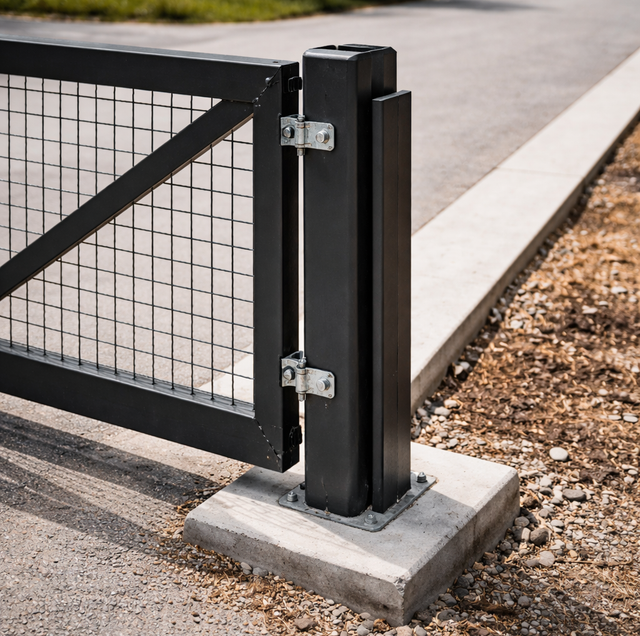
Quick Answer: A driveway gate sags or drags because the load path that holds it up has failed somewhere: a hinge post has leaned, a footing has shifted, the frame has racked out of square, the hinges have worn, or (on a slide gate) the track and rollers have moved. Find which one before you touch a wrench, because tightening a hinge on a leaning post buys you a week, not a fix.
A driveway gate is one of the heaviest moving things on a residential property. A steel or wrought-iron swing leaf can run well over a hundred pounds, and every ounce of that weight hangs off two hinge points and one post. When the gate starts to scrape the driveway, drop at the latch, or refuse to meet its catch, the metal is telling you the load path has moved. The useful question is not "how do I lift it back up" but "which part gave, and why." Get that wrong, and the sag comes back, usually worse.
What "Sagging" Actually Means On A Gate
There are two different failures people lump under "sagging," and they get fixed in opposite ways.
The first is the whole gate dropping. The latch side hangs lower than the hinge side, so the gate scrapes an arc into the driveway and the latch no longer lines up with its keeper. This almost always traces back to the hinge side: the post, the footing under it, or the hinges themselves.
The second is the frame racking. The gate is still roughly the right height at the post, but the rectangle has deformed into a parallelogram. The bottom corner on the latch side sags while the top stays put, and the gate twists so one edge drags before the rest. Racking is a frame problem, not a post problem, and no amount of hinge adjustment squares it back up.
Telling these two apart is the whole diagnosis.
Stand at the hinge post and sight up its face against the house or a plumb line. If the post leans, you have a post problem. If the post is dead plumb but the gate corner still droops, the frame has racked.
The Leaning Or Undersized Hinge Post
The hinge post carries the entire cantilevered weight of a swing gate, and it fights that load every hour of every day. A post that was set too shallow, in too little concrete, or in soil that holds water will slowly rotate toward the gate. You will see the top of the post tip inward and the gate nose dip in step with it.
Soil movement drives a lot of this. Ground that swells when wet and shrinks when it dries out cycles the footing loose over seasons, and heat-baked, low-clay ground can pull back from a footing just as readily as saturated ground can heave it. Either direction, the post ends up doing a slow lean.
Post size matters as much as depth. A four-inch post might be fine for a light walk gate and badly undersized for a twelve-foot drive leaf. When the post is too small in section, it does not tip so much as flex, and the gate develops a bounce at the far end that widens the gap at the latch every year.
The footing under the post: The fix for a leaning post is rarely the post. It is the concrete under it. A proper hinge-post footing for a heavy drive gate is deep, wide at the base, and poured as a single mass so the gate cannot lever it sideways. If the original footing was a shallow collar, resetting the post in a correctly sized footing is what actually holds. Before any digging for a new footing, call 811 so buried utilities get marked, because a driveway gate line often runs right past gas, water, and low-voltage runs.
The Racked Frame And Its Missing Brace
A gate frame is a rectangle, and a rectangle has no inherent resistance to being pushed into a parallelogram. The only thing keeping a swing gate square is a diagonal: either a rigid diagonal brace welded corner to corner, or an anti-sag cable with a turnbuckle run across the frame.
Here is the part people get backward. The diagonal has to run from the top corner on the hinge side down to the bottom corner on the latch side, so the brace is in compression or the cable is in tension pulling the drooping corner back up toward the hinge. A brace run the wrong way does nothing and can make the sag worse. A tired gate frame behaves like a bookshelf with no back panel: the moment you load it, the whole rectangle leans over into a lopsided diamond, and only a diagonal member across the back stops it.
Anti-sag cable versus welded brace: A welded steel diagonal is permanent and invisible inside a well-built frame. An anti-sag cable kit is the retrofit answer for a wood or light-metal gate that has already racked: the cable runs the correct diagonal, and the turnbuckle in the middle lets you crank tension until the latch corner lifts back into square. On a wood gate especially, the cable is doing a job the wood was never going to do on its own. Overtightening a turnbuckle can bow a light frame the other way, so it gets snugged in small turns while you watch the corner move.
Worn, Undersized, Or Loose Hinges
Hinges are the smallest parts in the whole assembly, and they carry the most concentrated load. A gate that has dropped only a little, with a plumb post and a square frame, is usually telling you the hinges have worn. The pin elongates its barrel, the bushing wears oval, and the leaf develops play that shows up as a droop at the latch.
There is also the matter of whether the hinges were ever big enough. A heavy drive gate wants heavy-duty hinges, and often more than two of them, so the load spreads across three or four points instead of two. Ball-bearing or bushed gate hinges hold up far better than a plain barrel hinge on a gate that swings dozens of times a day. Where the hinges are adjustable, backing the gate up to square is a real fix. Where they are worn out or simply too small, adjusting them just relocates the problem.
Slide Gates: A Different Failure Entirely
A slide gate does not hang off a post, so it does not sag the way a swing gate does. When a slide gate starts to drag, the trouble is almost always in the track, the rollers, or the ground the track sits on.
A ground-track (V-track) slide gate rides steel wheels in a rail set into the driveway. Debris packs into the V, the wheels flat-spot, or a section of track lifts, and the gate binds or drops as it rolls. A cantilever slide gate carries no ground track: it hangs from roller trucks on posts, and if one of those trucks wears or a post shifts, the gate noses down and scrapes at the far end of its travel. Either style also relies on guide wheels at the top that keep the gate vertical. When a guide roller seizes or falls off, the gate leans out of plumb and starts to rub its frame or the posts.
Ground movement hits slide gates hard because the track has to stay dead level over its whole length. Heave one end of a ground track up half an inch and the gate climbs a ramp and drags coming back down. Re-leveling the track bed, clearing and re-seating the rail, and replacing worn rollers is the slide-gate equivalent of squaring a swing frame.
Gate Weight And Span
Two numbers decide how hard every other part has to work: how much the gate weighs and how far it spans. A wide, solid-infill gate that blocks wind acts like a sail, and the twisting force at the latch grows with the plain length of the leaf. A gate that sags within a year of a good install is often a gate that was built heavier or wider than its post and hinges were sized for. Reducing that load, by switching a solid privacy leaf to a lighter picket design or splitting one wide leaf into a bi-parting pair, sometimes solves a sag that no amount of hardware ever will.
When To Call A Pro (And When It's A Safety Job)
Some of this is homeowner-tightening territory: snugging a turnbuckle, clearing debris from a slide track, checking whether a post is plumb. The line gets crossed the moment the gate is automated, the post has to be reset, or the gate has started to feel unstable.
A motorized gate is a genuine hazard when it sags, because the operator keeps driving a gate the mechanics can no longer support, and these systems carry crush and entrapment risk along with line-voltage and low-voltage electrical parts. Adjusting or diagnosing an automatic gate operator is a pro job, not a driveway-DIY.
A heavy gate on a failing post or a worn hinge is a falling hazard, since a leaf that drops off its pivot lands with its full weight. If the gate wobbles, if the post moves when you push the gate, or if you hear the hinges grinding, stop using it and get it looked at before it comes down on a car or a person.
Frequently Asked Questions
Hold a level against the hinge post and check plumb in two directions, then measure the gate's two diagonals corner to corner. If the post reads out of plumb, it's a post or footing issue. If the post is plumb but the two diagonal measurements differ by more than about a quarter inch, the frame has racked and needs a diagonal brace or cable, not a post reset.
Only a racked frame. A cable pulls a deformed rectangle back toward square, so it works on a gate that has twisted out of shape. It does nothing for a leaning post, a worn hinge, or a heaved slide track, and on a gate wider than roughly six feet, a single cable often can't hold square on its own, and a rigid welded diagonal is the better call.
A common working guideline is to set the post at least a third of its above-ground height into concrete, and deeper for tall or wind-loaded gates, with the footing widened at the base. The exact depth depends on gate weight, span, and soil, which is why a heavy drive gate footing is usually sized on site rather than from a rule of thumb.
A drag at one point of the swing, rather than a steady scrape, usually means the driveway itself is high there or the gate has a slight twist that only touches down at that angle. Raising the gate a touch at the hinges or grinding the high spot of a concrete pad clears it, whereas a full-arc scrape points back to a dropped hinge side.
No. Adding material at the bottom raises where the gate rubs but adds weight and does nothing about why it dropped, so it sags again onto the new rail. The load path, meaning the post, footing, hinges, or frame diagonal, has to be corrected first, then the gate is reset to the right ground clearance.
Two to three inches of ground clearance is typical for a swing gate, enough to clear seasonal ground movement and debris without leaving a gap a pet can slip under. A gate set with almost no clearance will start scraping after the smallest sag, which is why a gate that drags today may only have dropped a fraction of an inch.
Book a free on-site gate assessment — we will pinpoint the post, hinge, or frame at fault and give you a fix that holds. Sereno Custom Fence & Gates serves Phoenix and the Valley. Call (602) 353-7385.
