
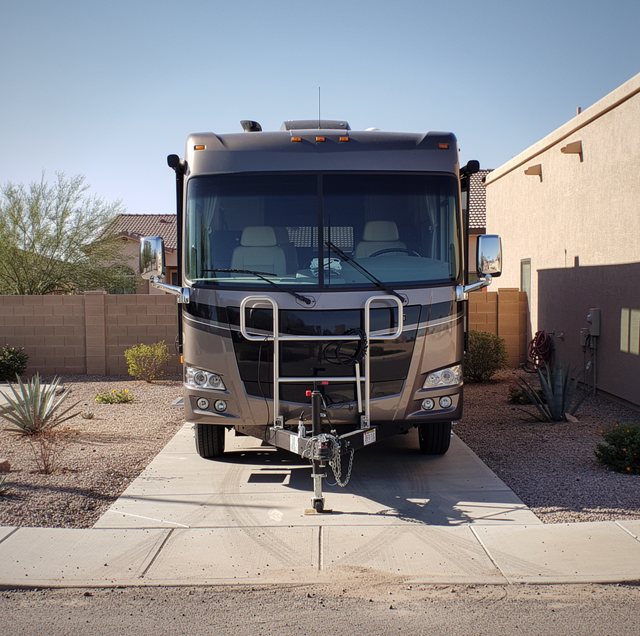
You back the motorhome toward the side yard the way you have for years, and this time the mirror kisses the gatepost. Or the boat trailer clears the opening fine going straight, but the moment it starts to turn off the driveway apron, the fender catches. A gate sized by eye, or sized to the last vehicle you owned, can be the reason. Getting the size right starts with a tape measure and the actual vehicle, not a guess at what "an RV gate" ought to be.
Clear Width Starts with the Vehicle's Widest Point
The number that matters is the widest point of the vehicle as it will pass through the opening, not the width printed on a spec sheet for the body alone. A motorhome's body can be 8 to 8.5 feet wide, but the side mirrors extend the real footprint by another foot or so past each edge. A boat on a trailer adds width beyond the hull: trailer fenders, guide posts, and any gear strapped to the gunwales all sit outside the boat itself and have to clear the posts, too.
Measure mirror to mirror with the mirrors in driving position, not folded flat against the cab, because folded mirrors aren't how the vehicle rolls down the street or through the gate on a normal pass. Then add a margin on top of that widest measurement. A gate cut to the exact width of the vehicle demands a driver line up dead center every single time, with no room for a crosswind push or a slightly off-angle approach. Clearance on each side beyond the mirrors turns "possible" into "routine."
The approach angle changes the width you need, too. A vehicle entering straight off a wide street squares up easily, but one turning in off a narrow alley or a tight side street arrives at the gate already angled, and an angled vehicle occupies more of the opening's width than its straight-line measurement suggests. Where the turn into the gate is tight, the opening must be wider than the straight-on measurement to accommodate the angle.
Before the posts go in, set two cones where the new posts will stand and drive the vehicle through slowly with someone watching each side. A tight pass between the cones shows the margin a tape measure alone misses.
Clear Height Where a Frame or Overhead Crosses
Height is easy to overlook because nothing about a driveway looks short until a roof-mounted air conditioner meets a header or arch over the gate. The number to measure is the vehicle's tallest point as loaded and ready to travel: the roofline plus any air conditioner, vent cover, antenna, ladder, or satellite dish bolted to the top. A boat and trailer combination measures from the ground to the highest point of the hull, hardtop, or any gear stowed above the gunwale line.
That height only matters where something crosses the opening above the ground. A gate hung without an overhead header or arch, just two posts and a leaf that stops at its own height, removes the overhead constraint entirely; nothing spans the opening above the vehicle. A gate design that does include a header, or an opening that runs under a carport eave, a power line, or a tree limb, has to clear the vehicle's fully loaded height with room to spare, not just match it.
The Turning Path and the Approach
A gate can be wide enough and tall enough and still not work if the vehicle can't get lined up to use it. A motorhome's own turning radius decides how tight a corner it can take entering the gate, and a towed trailer behaves differently again: a trailer tracks a shorter path than the tow vehicle through a turn, cutting the corner rather than following the same arc, which can put a trailer's wheels or fender closer to a gatepost than the tow vehicle's path alone would suggest.
The ground before the gate changes how much of that opening gets used. A driveway or alley that gives a vehicle room to square up before it reaches the posts lets it enter square, using the opening's full width. A site where the vehicle has to turn sharply right at the gate, with no room to straighten out first, needs a wider opening than the same vehicle would need on a straight approach, because it enters the gate still mid-turn rather than pointed through it. Length counts once the rig is through because the gate has to close behind it: the pad inside needs the rig's full length clear of the gate line, including the hitch, a rear ladder, and any bumper-mounted carrier.
Swing or Slide on a Wide Opening
Swing needs clear arc room equal to the leaf's length, and slide needs a level, clear run beside the opening, so the site's side room and slope settle the choice, not the vehicle.
What a Wide, Heavy Gate Asks of Its Posts and Footings
A gate built to pass a motorhome or a boat trailer is a different structure than a walk gate or a standard driveway leaf. The panel is wider, which means more surface area catching wind even on an open picket design, and a wide leaf swinging on a single hinge post puts more cantilevered load on that post than a narrower gate ever would. Splitting a wide opening into two leaves, each on its own post, divides that load.
The ground beneath that footing isn't uniform everywhere. Where a post hole goes in clean, straight down without a fight, the footing size for a wide, heavy gate is set mainly by the gate's own weight and how much wind it catches. Where the ground includes a hard, cemented soil layer that stops a post-hole auger cold, reaching a proper footing depth is its own job before the gate's weight even enters the calculation, and a footing poured shallow to avoid that layer ends up shallower than the gate's weight and span call for. Either way, a gate built for an RV or a boat should have a footing sized for its own weight and span, not for the fence panels on either side.
The Measurements Worth Taking, and Why
| Measurement | Why It Matters |
|---|---|
| Vehicle body width, widest point | The baseline the opening has to clear before anything else is added |
| Mirror-to-mirror width, mirrors extended | Mirrors sit outside the body and are the first thing to strike a post |
| Total height loaded, including roof equipment | Anything crossing above the opening has to clear this number, not the roofline alone |
| Height and location of any overhead obstruction | Determines whether the gate design itself, or something above it, is the real limit |
| Room to square up before the gate | Sets how much extra width the opening needs to absorb an angled approach |
| Existing post-to-post width at the opening | The number the new gate has to beat, measured, not assumed |
| Rig length, hitch to rear carrier | The pad inside has to hold the whole rig clear of the gate line so the gate can close behind it |
Frequently Asked Questions
Measure it the way it rides on the road, with the motor in the position you trail it in and anything stowed above the gunwale in place. Motor position changes the rig's length at the stern and can change its highest point, so the tape goes on the trailered setup, not the boat at the dock.
Extended tow mirrors, the kind bolted on or clipped over factory mirrors for pulling a wide trailer, are built to sit farther out than the vehicle's stock mirrors and don't always fold flush. Measure the mirror setup that's on the tow vehicle when it's towing, not the vehicle's unmodified width.
Yes. Hinge knuckles, a drop rod, and a leaf that stops short of fully open all sit inside the post-to-post width, so the clear opening is measured with the gate open, from the open leaf to the far post.
Yes: where the grade changes right at the gate, the front of a long motorhome pitches upward as it crosses the transition, which can lift the roofline closer to an overhead obstruction at the exact point the vehicle passes under it. Height should be checked with the vehicle angled up the apron, not measured on level ground alone.
A spare mounted on the trailer's side adds to its width, and a bow winch stand, or a raised tongue jack, can set the height at the front of the rig, so measure with both in their travel positions.
A dedicated pedestrian gate keeps someone on foot from having to swing or slide the full-width gate to walk through, which reduces the cycles the wide gate's hinges or hardware experience over its life.
Get your RV or boat gate measured and sized right — a technician confirms width, height, and footing specs before the gate is built. Sereno Custom Fence & Gates serves Phoenix and the Valley. Call (602) 353-7385.