
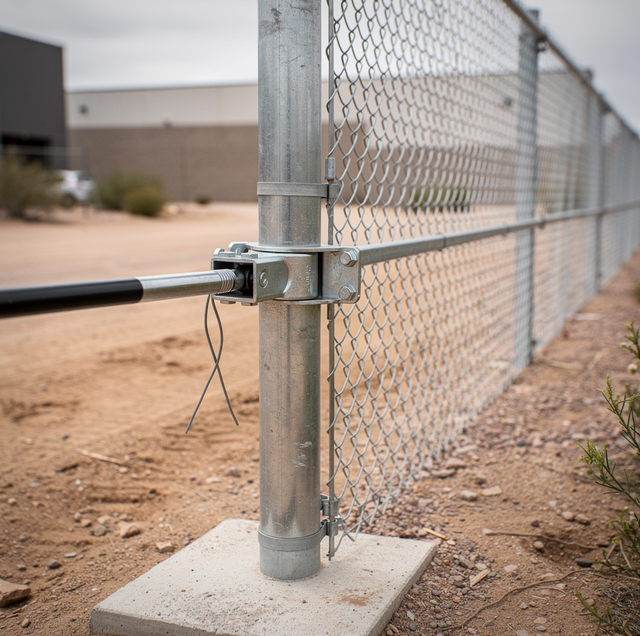
If the fabric itself had stretched, the dip would spread evenly along the whole line, and every diamond would open a little wider than the ones packed against the end post. A run that sags through the middle and holds at both ends has put all of its slack into the span between two fixed points, where gravity gathers it at the lowest point.
Chain link holds its shape by load rather than by joinery. The fabric is pulled end to end between the heavy posts, then tied to the line posts and the rail, which carry it without pulling on it. So the sag is a tension measurement taken with your eyes, and the question is which end stopped pulling.
Why Is the Middle Where the Slack Lands?
Only the two end posts pull on your run. Everything between holds it up and keeps it plumb, at spacings standard chain-link construction limits to no more than ten feet on center. A tie wire carries weight and line while the pull passes it by, so any slack along that length is free to travel and settle where the fabric hangs lowest.
Fabric can also lengthen without a wire yielding, because a diamond changes angle: pull along the run and each one opens along the pull and narrows across it. A run brought to tension at install has taken that movement out already; one bolted up without being pulled takes it later, under its own weight. The installation requirement comes down to five words: stretched taut, free of sag.
Because the slack travels, the dip's depth carries less information than its position. A line low along its whole length points at tension let go at one end. A single low bay with tight fabric either side points at something local, a broken tie or a leaning post. Your eye wants the lowest point; the useful look is at your two ends.
An End Post That Has Moved Inward
A tensioned run pulls its end posts inward, and if one walks toward the middle, the fabric is longer than the span it now crosses. Half an inch of movement at the top of a post is half an inch of surplus, and a hanging length turns very little surplus into a lot of dip. Spread it evenly across a hundred-foot run, tied every ten feet, and each bay gains five hundredths of an inch, lowering that bay's middle by an inch and a half. That is the floor. Slack travels, and the whole half-inch reaching one bay drops it more than three times as far.
Movement that small needs a level against your post to catch. Bracing is the part to check. Standard chain-link construction calls for terminal posts to be braced and trussed on fences six feet and higher, and on five-foot fences without a top rail, with a brace rail back to the first line post and a truss rod assembly rated for two thousand pounds.
The connection can give where your post has not. Bolts through the end clamps sit in the load path, and one backing off or a hole worn oval lets the fabric creep past by a fraction of an inch.
Load the Top Member Was Never Given
In a fence built with a top rail, that rail is a compression and alignment member. It is 1.66-inch outside-diameter pipe, tied to the fabric at intervals of no more than eighteen inches, and it carries no tightener anywhere on it. Once your fabric goes slack, its weight stops riding on the pull between the end posts and starts hanging off those ties, loading the rail downward between line posts. A bowed rail is the second thing to go, and straightening it while the fabric is still loose puts the bow back.
A run built without a top rail carries a top tension wire instead, and that member does pull. Standard practice places it four inches down from the top of the fabric, stretched taut on its own before the fabric goes up, and anchors it to the end posts with a band. So a run built that way gives you one more place to look. A slack top wire drops your whole top edge at once along the entire line, while slack fabric leaves that edge straight and opens up underneath it.
How Is a Slack Run Pulled Tight Again?
A crew works your run in a fixed order, and the order exists because each step removes a constraint on the next. Nothing is pulled until the thing being pulled against has stopped moving.
So the posts go first. An end post that has leaned is reset and then left alone while its footing gains strength, and the brace-and-truss assembly behind it is checked and tightened when there is no load on it.
Then the fabric is freed. Ties along your line posts and the rail are cut, which lets the whole length move as one piece, and the bolts at the end are backed off only after that, since until the ties are gone the fabric cannot travel anyway.
Only then is the run pulled. A stretcher bar is threaded through your mesh a few feet in from the post, and a puller draws it in, with the crew standing clear of the line of the pull for as long as the tool is loaded, because fabric and puller together hold a real quantity of stored energy. The end hardware is bolted back, and the ties go on last.
The Tension Bar and Its Bands
Put a hand on the last vertical in your run, where your fabric meets the end post, and you are holding the tension bar. It is a flat steel bar woven down through one full row of diamonds, and standard chain-link tension hardware runs as a one-piece length two inches shorter than the fabric, at least three-sixteenths by three-quarters of an inch in section for two-inch mesh. Clamped around it and the post sit the tension bands, pressed steel at least 0.105 inch thick and three-quarters of an inch wide, bolted through with five-sixteenths-inch galvanized carriage bolts no more than twelve inches apart.
Everything downstream of that clamp is only as tight as the clamp is. A band forced open by an earlier pull no longer sits flush against the post, so it grips on two edges and lets the bar turn under load before it catches. A bolt run up finger-tight holds until the first hard wind, then slips and releases the run's tension in one place. Both leave a post standing plumb, so the check that finds them is a wrench on those bolts.
Frequently Asked Questions
No. The fabric stays on the posts, but everything holding it in place has to let go first. The ties at the line posts and along the rail are cut and replaced, and standard practice for a tie is a full wrap around the post and one fabric picket with the two ends twisted three complete turns. Your old ties will not survive being opened, so expect new ones.
Yes, and it is measurable. Steel changes length by roughly six and a half millionths of its own length per degree Fahrenheit, so a hundred-foot run moves about three-eighths of an inch over a fifty-degree swing. That is small beside a real sag and large enough to matter on a borderline one, so look at your fence twice, at two times of day, before you call your run slack.
The terminal posts. That term covers the end, corner, and gate posts, and adds the pull post, set into a long straight line so the run terminates and is tensioned in two shorter lengths. A line post carries your fabric and takes no part in the pull. If your fence has a pull post, you will see a brace assembly on both sides of it.
Later than the surface suggests. The concrete mix in that footing prints its own working time and its own time before the footing can take load, and those are two different figures on the same bag. A footing hard to the touch is not necessarily ready for a horizontal pull, which is the load a tensioned run puts on your end post for the rest of its life.
They do not carry it. Standard spacing places ties no more than 12 inches apart at a line post and 18 inches apart along a rail, and a tie holds the fabric's weight and its line while the pull passes it by. The same spacing rule places a bottom tension wire four inches up from the bottom edge and fixes your fabric to it with hog rings no more than eighteen inches apart.
The gauge number runs backward. On the standard wire gauge table, six gauge measures 0.192 inches across and eleven-and-a-half gauge 0.113 inches, so a lower number is a thicker wire, and a smaller diamond puts more of it into the same run. Selvage is the edge finish, knuckled where adjacent wire pairs bend into a loop and twisted where they are wound together. Read those figures off your own fabric's tag.
Schedule a site visit before anything is loosened or pulled — a leaning end post gets reset and left to cure first, so the fabric is tensioned against a post that has stopped moving. Sereno Custom Fence & Gates serves Phoenix and the Valley. Call (602) 353-7385.