
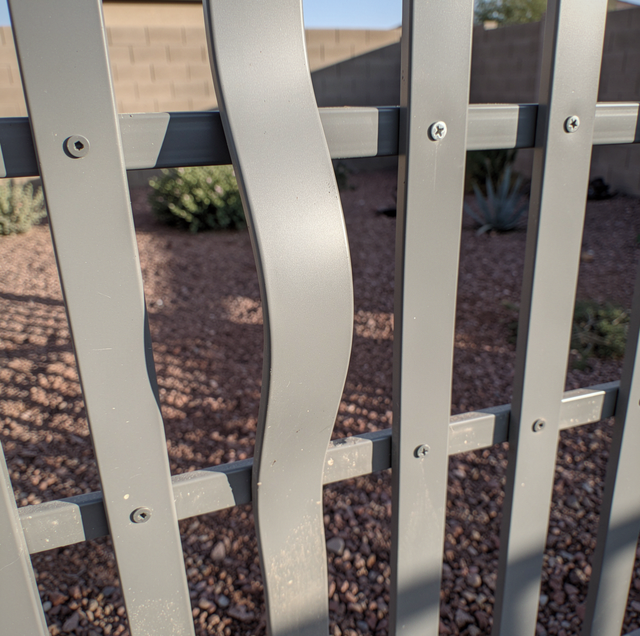
An aluminum fence panel is built from vertical pickets running between a top and bottom rail, either passing through punched holes in the rails or fastened to them with screws or clips, and the assembled panel is then set between posts or bracketed to their faces. That construction is why a bend's location matters more than its size when you're weighing a fix: a picket bent by a stray impact, a rail kinked at its connection point, and a post leaning at its base are three separate repairs, not variations on the same one. Working out which piece took the damage comes first and determines everything that follows. Each kind of damage pairs with its own repair path:
| Damage | What It Means | Repair Path |
|---|---|---|
| One picket bowed, no sharp crease | The impact was absorbed by a single picket's give | Straighten in place, or swap that one picket |
| Several pickets bent from one impact | The force spread across more of the panel's width | Multi-picket replacement, or panel-wide straightening |
| A rail kinked or pulled from its bracket | The panel's structural spine is compromised | Rail replacement and bracket re-set |
| A post leaning or bent at the base | A foundation-level problem, not the panel | Post repair or replacement, then the panel gets refit |
| The finish cracked or chipped at the bend | Bare metal exposed right at that point | Touch-up alongside whichever structural repair applies |
| A panel out of line with its neighbors | The post or bracket behind it is off, not a flat panel defect | Check the post and bracket before touching the panel |
A bent pool-fence panel can leave the barrier open, so children stay away from the pool until a fence crew closes the gap. Standing on or pulling a leaning panel can crack bent aluminum and leave a sharp edge.
Why Aluminum Bends and What Re-Bending Does to It
Aluminum earns its place on a fence panel partly because it's softer than iron or steel, and that same softness is why it dents and bends rather than snapping outright when something hits it: a ladder, a vehicle bumper, a gate blown against it, or a hard push. That give has a limit. A picket or rail bent back once toward true still has metal left to move. Bent back a second time at the same crease, or forced past where it wants to go, the metal can crack right at the fold instead of smoothing out again. A crack is a structural break, not a shape that touch-up paint or another round of straightening can fix, so a cracked piece moves from a straightening job to a replacement. Each bend work-hardens the aluminum right at the fold, leaving that spot stiffer and more brittle than the surrounding metal, which is why a second bend in the same place can crack there.
Straightening a Section in Place and When It Holds
A picket or rail bowed in a broad, even curve, with no sharp fold anywhere along it, is a candidate for straightening in place, with the crew working it back the way it came under even, steady pressure. A sharp kink is a different case. That's the metal already folded at a hard angle rather than bowed, and pushing a kink flat concentrates the force right at that fold instead of spreading it, which is where the crack described above starts. A kinked picket or rail, as opposed to a bowed one, requires replacement rather than straightening, even though the two can look alike from a few feet away.
Replacing a Picket, a Rail, or a Whole Panel
When straightening isn't the right call, the repair happens at whichever level failed. A single picket on a panel whose pickets are held with screws or clips comes out and goes back in without disturbing the pickets on either side, matched to the run's spacing, profile, and height so the swap doesn't stand out. A kinked or pulled rail is a bigger job, since the rail carries every picket end along its length: replacing it means resetting the pickets it holds, not just the one piece of metal. When damage spans a rail and several pickets together, or the panel's finish is already compromised on top of the structural damage, swapping the whole panel can be the cleaner path, matched in style, height, and color to the panels on either side so the repaired section doesn't read as a patch.
The Post and Bracket Behind the Panel
A panel is only as straight as what it's set into, and that's worth checking before the panel itself takes the blame. A bracket connects the post to the panel's end rail with its own fasteners, separate from the fasteners that hold the pickets in place, so the two connections can be checked without disturbing each other. A post that leans or is bent at its base throws the panel it holds out of line, even when the panel is undamaged, because the panel follows the post's angle rather than its own. Reinforcing or replacing a bent post has to happen before the panel is refitted or realigned; setting a straightened or new panel onto a post that's still off just carries the lean into the new repair, and the job ends up being done twice instead of once.
The Finish at the Damage Point
A crack or chip in the coating at the bend leaves bare aluminum exposed, and that's worth addressing alongside the structural fix, not as a separate cosmetic step tacked on later. Aluminum itself will not rust, even where the coating is breached, but exposed metal can still corrode or oxidize at the point of the chip, especially where moisture sits against it, so the touch-up carries real weight even though the panel isn't at risk of rusting through the way an iron one would be. Whatever fixes the bend, whether that's straightening, a picket swap, or a new panel, the touch-up at the damage point belongs in the same repair.
When Replacing the Panel Beats Working the Old One
There's a point where swapping the whole panel makes more sense than continuing to work the one that's there. A panel that's already straightened once at a given spot and then takes another hit in the same place is closer to its crack limit than a panel that's never been bent, so a repeat bend at the same crease is a fair trigger to replace rather than straighten again. Damage that runs along several pickets and the rail they share involves enough separate pieces that a whole-panel swap can be the simpler repair. And a panel whose finish is already worn or chalking across its surface, not just at the point of damage, is carrying two separate problems at once: the structural damage and the finish failure. Repairing only the structural side leaves the finish problem in place, which is why a full panel swap is worth weighing at that point.
A four-foot level held against two adjacent faces of the post shows whether it leans along the fence line or out from it, and a post that reads plumb on both faces clears the post itself.
Frequently Asked Questions
Only when its profile and height match the run it joins. The rail's holes are punched to fit one picket profile, so a picket from another style can fail to seat in them or stand out of line with its neighbors, and the swap then moves up to the rail.
No. The bracket connecting the panel to the post is separate hardware, and it can bend or work loose on its own while the post underneath stays sound. A post that checks out plumb but still holds a crooked panel means the bracket or the panel itself is the bent piece, not the post, and the two get fixed differently.
No. It can sometimes be reinforced when the bend is minor, and the footing is sound. A post bent at or below grade, where the bend involves the footing itself, needs full replacement.
Powder-coat color and sheen can vary between production runs, so a new piece ordered years after the original panel went up isn't guaranteed to match the exact shade, even if it's the same named color. Ordering replacement pieces together when several need swapping, rather than one at a time on separate visits, yields the closest match.
It is more urgent than a bowed one: wind pressure or another knock can open a crack further or separate the picket at that point, so a cracked picket is worth moving up the list.
Yes, and on a pool fence it is a safety matter. A picket pushed out of true changes the gap between it and its neighbors, and that spacing is exactly what a pool barrier's design depends on: a gap that opens even slightly can be enough for a small child to fit through where the pickets once sat evenly spaced. It's a safety question independent of how noticeable the bend looks from a distance.
Commission aluminum fence repair — realignment or replacement of bent sections matched to the run, post reinforcement or replacement, and finish touch-up at the point of damage. Sereno Custom Fence & Gates serves Phoenix and the Valley. Call (602) 353-7385.