
Signs Your Automatic Gate Opener Is About to Fail
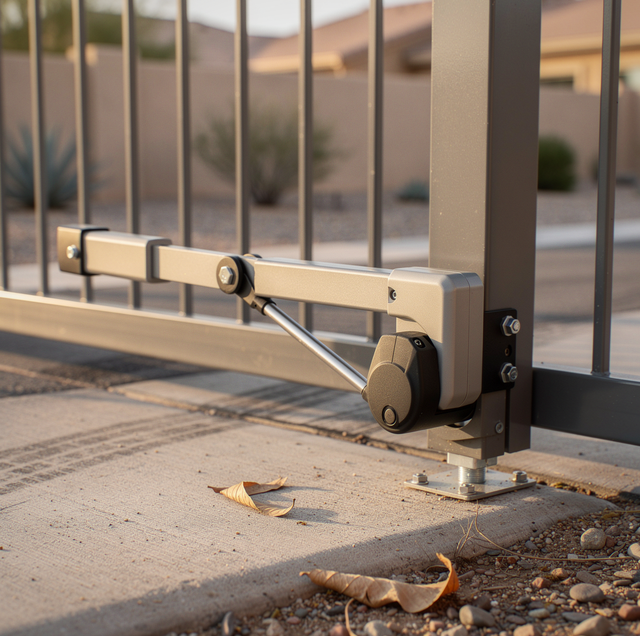
The gate used to swing shut the second the sensor cleared. Lately it hangs open a beat too long, then eases closed like it's thinking about it. Nothing has actually broken yet, but something inside that motor housing is already further along than it looks from the driveway.
How an Automatic Gate Opener Actually Moves the Gate
A swing gate operator drives the gate through its arc one of two ways: a linear actuator that extends and retracts like a piston, or an articulated arm pushed by a gear-reduction motor. Either way, a control board reads input from a wall switch, keypad, or radio receiver, then sends power to the motor while a set of limit switches or a rotary encoder tells the board exactly where the gate sits in its travel. A slide gate operator works differently: a gear-driven motor engages a rack bolted along the bottom rail of the gate, pulling it along a track or, on a cantilever system, along internal rollers with no ground track at all.
Layered on top of the motor and gearing sits a safety system: photo-eye sensors that break a beam across the opening, and sometimes a pressure-sensitive edge on the leading edge of the gate. Either one tells the board to stop and reverse if something is in the path. That safety layer is doing exactly what it's supposed to when a healthy gate reverses on an obstruction. It's a different story when a gate reverses on nothing at all.
The Warning Signs, In Order Of How Much Time You Have
Not every symptom means the same thing, and not every symptom means the same urgency. Some point to a part that's simply due for lubrication. Others mean a component is actively failing mid-cycle.
| Symptom | What's Likely Happening | How Much Time You Probably Have |
|---|---|---|
| Gate moves noticeably slower than it used to | The gear-reduction motor is wearing internally, or a drive chain has stretched | Weeks to a couple of months |
| Gate stops mid-travel and reverses with nothing in the way | An obstruction sensor is over-tripping, often from a worn drive gear or a photo-eye picking up dust | Days to weeks; the safety system is compensating for something else |
| A relay clicks, but the gate doesn't move | A capacitor has failed, common on AC swing arm motors, or a fuse has blown on the control board | Could already be down; worth checking now |
| The remote works sometimes and not others | A loosened receiver antenna connection or a weak transmitter battery, not a motor problem | Not urgent, but isolate the cause before assuming the motor's at fault |
| Gate opens fine but won't fully latch closed | A limit switch has drifted out of adjustment, or a track wheel has worn unevenly | Adjustable now; ignored, it strains the motor with every cycle |
| Motor housing hums, grinds, or feels warm after a cycle | Bearings are wearing out, or a nylon drive gear is stripping its teeth | Days; this is usually the last stage before the gear seizes |
Mechanical Or Electrical? A Two-Minute Test
Most operators have a manual release, a lever or a key-turned disconnect that decouples the motor from the gate. Trip it and move the gate by hand. If it swings or slides smoothly with no more resistance than pushing any gate its size, the failure is on the electrical side: the board, a capacitor, a sensor, or a loose wire. If the gate itself feels stiff, grinds, or binds when you move it by hand, the problem is mechanical, inside the gearbox, at the hinges, or in the track and rollers, and no amount of board troubleshooting will fix that.
Why Not All Swing Operators Fail The Same Way
A screw-drive operator pushes the gate open using a threaded rod that turns inside a tube, converting the motor's rotation into a straight-line push. These tend to fail slowly, since the failure mode is usually the internal thread or nut wearing rather than a sudden break, which is why a screw-drive gate often shows the "slower than it used to be" symptom weeks before anything else changes. An articulated arm operator, by contrast, uses a folding linkage that pushes and pulls through a changing angle as the gate swings, so wear shows up first at the linkage pins and bushings rather than the motor itself, and a worn pin often shows up as a faint knock or hesitation right as the arm changes direction partway through the swing. Underground operators, mounted in a box set below grade at the hinge point, hide their gearing from view entirely, which means a failing underground unit gives fewer visual clues and usually announces itself only through sound, a change in speed, or the smell of hot gear oil rising from the access cover.
What Actually Shortens An Opener's Working Life
The parts that fail first are almost never the motor's main windings. They're the components exposed to the outside environment every single cycle. Dust and grit work their way into gear housings that aren't fully sealed, and the factory grease inside gradually dries out, losing its ability to cushion the gears as it did when new. Slide gate tracks collect windblown debris along their full run, and a wheel rolling over grit wears unevenly instead of smoothly. Irrigation overspray reaching the operator's electrical enclosure or wiring connections introduces moisture where corrosion can start on contacts that were never meant to get wet. Solar-powered systems, common on driveway and RV gates without a nearby power run, depend on a deep-cycle battery that degrades on its own timeline regardless of how the motor itself is holding up.
Preventive Checks That Catch A Failure Before It Strands The Gate
A little attention to a schedule catches most of the symptoms above while they're still cheap fixes, rather than a stuck gate at midnight.
- Lubricate the drive chain or gear quarterly with the grease the manufacturer specifies, not a general-purpose oil that attracts and holds grit
- Wipe photo-eye lenses clean and confirm they still have a clear sightline across the opening
- Clear debris from a slide gate's track before it packs into the roller wheels
- Trip the manual release monthly so it doesn't seize from disuse right when a power outage calls for it
- Load-test a solar system's backup battery once a year rather than assuming it's fine until the gate won't move
When Repair No Longer Makes Sense
Some failures are worth fixing on their own: a capacitor, a photo-eye, a worn gear. Others are a sign the whole operator has reached the end of its practical life. A control board that's been discontinued by the manufacturer, where a technician can no longer source the exact replacement part, is one signal. So is a motor that's had the same failure repaired twice in two years; a repeated failure at the same point usually means a related component nearby is also near the end of its service life and will fail next. At that stage, a full operator swap resets the clock on every part at once, rather than chasing one worn component after another.
Frequently Asked Questions
Gear-driven arm operators commonly run 10 to 15 years before the motor itself needs replacing, but capacitors and control boards often need attention around the 7- to 10-year mark even while the motor is still fine, since electronic components and mechanical gearing wear on different timelines.
Often, yes: universal replacement control boards exist for older AC swing-arm operators, and in many cases the arm and motor assembly can be swapped out while keeping the existing posts and gate leaf, avoiding a full system replacement.
Short-term manual operation is fine, but leaving the release engaged for an extended stretch lets the gate swing loose in wind since nothing is holding its position between uses, which puts extra stress on the hinges that the motor would otherwise absorb.
Not really: a relay clicking repeatedly without the gate fully engaging usually means a circuit isn't completing on the first try, and letting that happen cycle after cycle can burn the relay's contacts, turning a simple board repair into a full board replacement.
No; backup batteries are sized for a limited number of cycles during a power outage, not for continuous daily use, so relying on battery power for regular operation drains them, shortens their life, and risks leaving the gate open or closed once they're depleted.
A marginal panel or aging battery can keep up with morning cycling but fall behind by late day if the battery hasn't fully recharged, so intermittent late-day sluggishness often points to the battery or charge controller rather than the motor itself.
Why does one opener give weeks of warning while another dies on a single clicked relay? Because motor, gearing, sensors, board, and power source are five separate systems operating on five separate timelines, whichever one is furthest along determines how much runway is left. Catch the pattern while it's still just one component acting up, and it stays a small fix rather than a gate that won't move at all.
Get a gate opener inspected before it fails — a technician can test the motor, sensors, and control board on-site and recommend a repair or a full replacement. Sereno Custom Fence & Gates serves Phoenix and the Valley. Call (602) 353-7385.
