
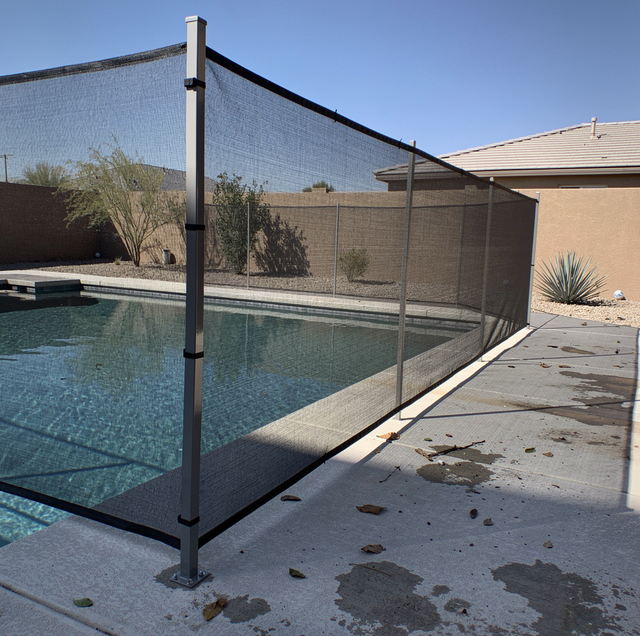
A rolled-up mesh pool fence, poles spaced a few feet apart with a see-through weave stretched between them, looks like it wouldn't stop a determined four-year-old for long. Set next to a welded iron fence with pickets barely wide enough to slip a hand through, the mesh version reads as the compromise choice. That impression has the mechanics backward.
The Myth: Fence Material Determines Whether A Kid Can Get Through
Pool-barrier effectiveness comes down to a handful of specific dimensions and details: how far apart the vertical members are spaced, whether there's any horizontal surface a small foot or hand can use as a step, how the gate latches, and how rigid the barrier remains under a push or a pull. A mesh fence built to those specifications keeps a small child on the other side exactly as reliably as an iron fence built to the same specifications. What material actually changes is durability, how much you can see through the fence, and whether the barrier can come down when it isn't needed, not whether a toddler can defeat it.
How Mesh Fencing Actually Keeps A Small Child Out
A mesh pool fence uses polyester mesh strung under tension between spring-loaded poles, each set into a ground sleeve anchored below grade. That tension is doing the structural work: a properly tensioned panel resists a push the way a trampoline surface resists weight, while a loose or sagging panel gives way and becomes climbable almost immediately. The mesh weave is sized small enough that fingers and toes can't get a real foothold, and, critically, there's no horizontal rail anywhere on the fence. A horizontal member at any height functions like a ladder rung, the single most common way a small child scales a barrier that otherwise appears secure.
How Iron Fencing Actually Keeps A Small Child Out
An iron pool fence relies on picket spacing rather than tension. Vertical pickets are set close enough together, commonly no more than around four inches apart, that a child's body can't pass between them even where a hand or a foot might fit through. The pickets run into a continuous bottom rail or a footing at ground level, closing off any gap to squeeze under, and any decorative element or horizontal rail on the outside face is positioned so it doesn't create a foothold to climb up and over.
Mesh vs Iron: Side-by-Side Comparison
| Factor | Mesh Fence | Iron Fence |
|---|---|---|
| Primary safety mechanism | Tension across the panel resists climbing; no horizontal members | Picket spacing prevents passage; no horizontal foothold |
| Visibility through the fence | High; the weave is see-through | Moderate, depends on how closely pickets are set |
| Seasonal removal | Poles lift out of ground sleeves for full removal | Permanent installation |
| Response to a hard gust | Panels can luff if pole sleeves aren't set to full depth | Rigid; unaffected by wind loading on the panel itself |
| Gate hardware | Self-latching, self-closing spring hinge | Self-latching, self-closing spring hinge |
| Ongoing check | Pole tension and sleeve fit each season | Loose pickets or hardware corrosion |
| Typical service life of the barrier itself | Panels replaced on a multi-year cycle as UV exposure weakens the fibers | Structure lasts far longer; hardware needs its own attention |
Why The Gate Matters More Than Either Fence Material
A fence, whichever material it's built from, only works as a barrier when the gate is closed and latched. A self-latching, self-closing gate with its release mechanism mounted high enough that a small child can't reach it, positioned on the pool side of the fence rather than the yard side, is what actually prevents unsupervised access in the specific moment a fence alone can't cover: the moment someone walks through and doesn't pull the gate shut behind them. Both mesh and iron systems use the same category of spring-hinge, self-latching hardware; the fence material underneath the gate doesn't change that requirement at all. Exact latch-height and gate-swing specifications vary by local code, so confirm the specifics with the local building department before installation.
What Actually Defeats A Pool Barrier, Regardless Of Material
Most pool-barrier failures don't come from a child climbing the fence itself. They come from something placed near the fence that effectively lowers it: a patio chair, a planter, a stack of pool toys, or an air conditioning unit within easy reach of the outside face. Anything close enough to the fence line that a small child could stand on it and reach the top rail shortens the barrier by however tall that object is, which matters exactly as much whether the fence behind it is mesh or iron. A propped-open gate, even briefly, defeats both fence types identically, since neither material does anything once the barrier has a gap in it.
How Each System Actually Gets Installed
A mesh pool fence installs around the existing pool deck or yard perimeter using ground sleeves set into the concrete or soil at measured intervals, one for each pole. The poles drop into those sleeves and the mesh panel tensions between them, with a top and bottom cable or webbing running the length of each section to keep the tension even instead of concentrated at just the pole connections. Getting that tension right matters more than almost anything else about the installation: a panel installed even slightly loose loses the rigidity that makes it climb-resistant in the first place. Most mesh systems include a tension gauge or a simple pull test that the installer checks at each pole during setup, and that same check is worth repeating seasonally, since ground movement, a sleeve working loose, or a pole that's been bumped can all quietly reduce tension well before the panel looks visibly slack.
An iron pool fence installs more like a permanent fence line: posts set into concrete footings at fixed spacing, with pre-welded picket panels or individually set pickets running between them. Because the barrier's effectiveness depends on picket spacing rather than tension, there's no equivalent to a mesh panel losing rigidity over time. What an iron fence does need is a level, plumb post line, since a post that leans even a little can open a gap at the bottom wide enough to compromise the spacing the whole system depends on. That's why an installer checks each post with a level before the concrete sets rather than after, since a post that's already cured in slightly out of plumb is a far bigger job to correct than one caught before the footing hardens.
What A Retrofit Looks Like On An Existing Pool
Adding a barrier to a pool that doesn't currently have one usually favors whichever system fits the existing deck and landscaping with the least disruption. Mesh fencing's sleeve-and-pole system needs only small anchor points rather than a continuous footing trench, which makes it a common retrofit choice around an existing paver or concrete deck where cutting a long footing line would mean tearing out finished hardscape. An iron fence retrofit, by contrast, usually works best where there's already a planting bed or unfinished ground along the pool's perimeter to accommodate footings, or where the property owner wants a permanent barrier that also functions as a decorative fence line year-round rather than a removable safety measure.
Can The Two Systems Be Combined On One Property?
It's fairly common to run iron fencing along a permanent property line, say between the pool area and a side yard, while using mesh fencing on the remaining sides where full-time visibility or a removable barrier matters more, such as a section facing the house where sightlines to the water are useful during a gathering. The two systems don't need matching hardware to work together; each gate on each section still needs its own self-latching, self-closing mechanism independent of what the adjoining fence sections are built from, and each barrier needs to close a complete loop around the pool on its own, since a gap where mesh meets iron is exactly as much of a gap as one in the middle of a single continuous fence.
Frequently Asked Questions
It can stay up permanently; the poles simply lift out of their ground sleeves whenever full removal is wanted, and the sleeves themselves sit flush with the deck or ground when the fence is down, so nothing creates a trip hazard for anyone walking through that area.
Yes, typically, though the signal to replace a mesh panel isn't a fixed number of years so much as tension that won't hold: once tightening the poles at the seasonal check no longer restores a properly taut panel, ultraviolet-weakened fibers have likely reached the end of their useful life. An iron fence's structure holds up for a much longer stretch, with corrosion at the base or hardware the more likely thing to check during that same visit.
Spacing gets measured so a roughly four-inch sphere can't pass through anywhere along the fence, which is why vertical pickets sit close enough together that any gap, whether between pickets or under a horizontal member, stays under that threshold.
Furniture and planters work the way described above; they give a child something to stand on and effectively lower the barrier's height. A climbing plant threatens the barrier through a different mechanism: a vine growing up through mesh weave can gradually pull a panel out of tension over a season, and on either fence type, a vine reaching the top rail can offer a handhold a bare picket or panel wouldn't otherwise have. Either way, it's worth cutting back before it fills in rather than after.
No, both rely on the same category of self-latching, self-closing spring hardware, though the mounting differs: an iron fence's latch plate bolts directly to the picket frame, while a mesh fence's gate shares the same pole-and-sleeve hardware as the rest of the panels.
Neither material reacts directly to pool chemistry, but hardware exposed to splash-out- the latches, hinges, and springs- benefits from a corrosion-resistant coating regardless of whether the fence itself is mesh or iron, since that hardware sees more moisture exposure than the fence panels do.
Height minimums vary by jurisdiction, but most residential pool barrier codes set the bar between 48 and 60 inches above grade, since a shorter panel can be climbed by an older child even when spacing and tension are otherwise correct. Confirm the exact minimum with the local building department or HOA before finalizing a height, since both mesh and iron systems can be built to meet whichever number applies to a given property.
Tension, spacing, a self-latching gate, and clear space around the perimeter are the four mechanisms that keep a small child on the safe side of the water, and each works the same way, no matter which material holds it. Get all four right on whichever fence goes in, and the material choice becomes the least important decision on the list.
Get a pool fence evaluated for proper spacing, tension, and gate hardware — a technician can confirm an existing barrier is holding up correctly or recommend a mesh or iron system built to the same standard. Sereno Custom Fence & Gates serves Phoenix and the Valley. Call (602) 353-7385.
