
Powder Coating a Metal Fence: Why the Finish Lasts
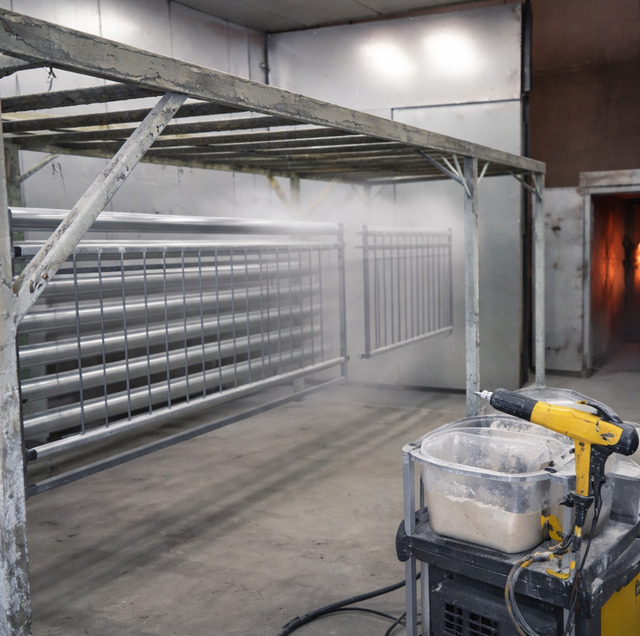
Quick Answer: Powder coating is a dry finish: a fine pigmented powder is given an electrostatic charge, sprayed onto clean bare metal, then baked in an oven until it melts and flows into one continuous plastic-like shell. That baked film is thicker, more uniform, and far more resistant to rust, chipping, and UV fade than ordinary spray paint. It lasts when the metal underneath is blasted clean and, for real corrosion protection, primed or galvanized first. It fails when prep was skipped, or moisture works under a chip.
A steel fence looks great the day it goes up and rough two summers later, with chalky paint, orange streaks at the welds, and flaking along the bottom rail. The finish is doing most of the work of keeping a metal fence alive, and not all finishes are equal. Powder coating is the one most fabrication shops reach for on iron and steel, and it behaves nothing like the liquid paint in a can.
What Powder Coating Actually Is
Before the benefits make sense, it helps to know that powder coating is not paint in the usual sense. There is no liquid, no solvent, and no brush or roller. The coating starts as a dry powder made of finely ground pigment and resin. A spray gun gives that powder a static electric charge, and the metal part is grounded, so the charged powder is pulled toward every surface and clings there like packing peanuts to a sweater, wrapping around edges and into corners on its own.
The coated part then goes into a curing oven, usually somewhere around 350 to 400 degrees Fahrenheit. The heat melts the powder, and it flows together into a smooth, gap-free film, then hardens as it cools into a tough shell bonded to the metal. What comes out is not a layer of dried liquid sitting on the surface but a fused skin that is part of the part.
Two things follow from that. This is a shop process, not a job you do in the yard with a rattle can: it needs an electrostatic gun and an oven big enough to hold the part. That's why an installer either powder coats fence panels and gates back at a fabrication shop before they are set, or sends the pieces out to a coater, rather than spraying them once they are hung.
How the Coating Goes On
The visible spray-and-bake step is short. The prep before it is what decides whether the finish lasts, and it runs in a fixed order.
Clean and strip the metal: Bare steel out of the shop carries mill scale, oil from handling, and often light surface rust. Powder will not bond to any of that. The metal gets degreased and then abrasive-blasted, so the powder grips raw, slightly roughened metal instead of a layer of grime.
Prime for corrosion, then coat: For a fence that lives outdoors, many shops add a corrosion layer under the color: a zinc-rich primer, or hot-dip galvanizing on the raw steel, so there is a sacrificial metal barrier between the steel and the world. The color powder goes on over that. Skipping this step is the single most common reason a good-looking coated fence rusts anyway.
Spray and cure: The charged powder is sprayed to an even build, then the part bakes until the powder flows and sets. One pass typically lays down a film several times thicker than a coat of spray paint, with no thin spots at the edges where rust usually starts.
A useful way to hold the difference in your head: liquid paint dries the way a puddle dries, thinner at the high points and pooled in the low ones, while powder coating sets the way candle wax hardens over what it was poured on, one even thickness that follows every contour.
Why It Beats Ordinary Spray Paint
Liquid paint and powder coating both add color, but they age very differently outdoors.
It goes on thicker and more evenly: A sprayed powder film is usually two to four times the thickness of a paint coat, and because the charged powder wraps edges and welds on its own, there are no starved spots at the exact places, corners, seams, and bottom rails where paint runs thin, and rust starts first.
It resists chips and scratches: The baked film is closer to hard plastic than to dried paint. A cart bumping a gate or a string trimmer clipping a picket that would scar bare paint often only scuffs powder coat.
It holds color and gloss longer: UV is what breaks paint down: it fades the pigment and chalks the surface into that dusty film you can wipe off with a finger. Powder coatings, especially the outdoor-grade resins, are formulated to resist that, so the color stays truer for years.
No drips, no runs, no solvent smell: Because there is no liquid carrier flashing off, the finish cures without sags or brush marks, and without releasing the solvents a wet paint job does.
The Prep That Makes It Last
The finish is only as good as what is under it. A flawless-looking coat over dirty or rusty steel is a slow-motion failure, because the bond is weak and moisture is already trapped against the metal.
Real longevity comes from the boring steps: blasting the metal to clean, bright steel so the powder actually keys into it, and adding a zinc primer or galvanizing underneath so that even if the top film is breached, the steel has a second line of defense. On an existing fence that already has rust, this matters even more. The rust has to be stripped back to sound metal first. Coating over active rust, or spot-painting a rusty fence, just seals the corrosion in to keep spreading out of sight.
One safety note on the prep: abrasive blasting throws off fine metal and silica dust that is a real respiratory hazard, which is one more reason it belongs in a shop with proper ventilation and respirators, not a driveway.
Color and Finish Options
Powder coating is not limited to gloss black, even if that is what most iron fences wear. The powders come in a wide range of colors and in several sheen levels, from flat and matte through satin to full high gloss. There are also textured finishes, a fine or coarse orange-peel texture, that hide minor surface imperfections and read less like a mirror.
Beyond flat color, shops can lay down finishes that mimic hammered metal or a wrinkled texture, and clear or tinted topcoats for a slightly different look. For an outdoor fence, the resin family matters as much as the shade: outdoor-rated powders hold up to sun far better than indoor-grade ones, so it is worth confirming the coating is meant to live outside, not just the color.
When Powder Coating Still Fails
A baked-on finish is tough, but it is not permanent, and it fails in predictable ways worth recognizing early.
The film can be breached. A deep scratch, a chip from an impact, or a drilled hole opens the coating down to bare metal. Once water reaches steel through that opening, rust starts underneath and spreads sideways under the coating, lifting it from below. That creeping rust under the edge of a chip is the classic powder-coat failure, and it is why a small chip is worth touching up quickly rather than waiting.
The other failure mode is bad prep, and it looks different: instead of starting at a chip, the coating lifts or bubbles over a broad area because it never bonded well, or because rust was sealed underneath from the start. That is a re-do, not a touch-up.
Maintaining a Powder-Coated Fence
The upkeep is light. Rinse the fence a few times a year to clear dust, pollen, and mineral film from sprinkler overspray, and a mild soap and a soft cloth handle anything that clings. Skip abrasive pads and harsh solvents, which can dull the finish.
When you spot a chip or deep scratch down to bare metal, clean it, let it dry, and dab it with a matching touch-up paint made for the job, so water never gets a foothold under the coating. A minute of touch-up now prevents the rust creep that turns into a stripped-and-recoated panel later.
Refinishing an Older Fence
An old fence with a tired or failing coat has two honest paths. If the coating is largely sound with a few worn spots, field touch-up, cleaning and dabbing the bad areas, buys real time. But once the finish is chalking, peeling, or rusting across whole sections, patching is cosmetic only.
The lasting fix is to strip it back: media-blast the panels and gates to bare metal, re-prime or re-galvanize, and powder coat again from scratch. That means the pieces usually come off and go to a shop, since the oven and blasting cannot come to the fence. It is more work than a coat of paint, but it resets the fence to a factory-grade finish rather than adding another layer over a failing one.
One thing no finish fixes: a heavy iron gate that sags or drags is a structural problem, not a coating one. The finish protects the metal, but the posts and footings carry the weight. A gate that has never hung right needs its posts and footings corrected regardless of how it is coated.
Frequently Asked Questions
Yes. Aluminum takes powder coating well and is common on lighter fence panels and pool fencing, since it will not rust even if the film is breached. Galvanized steel can be coated too, but it needs an extra prep step: the zinc surface is degassed or specially cleaned first so the powder bonds; otherwise, the coating can pinhole or lift.
A properly prepped, outdoor-grade coating commonly holds up well for roughly 10 to 20 years before it needs redoing, versus a few years for ordinary exterior spray paint. The spread depends almost entirely on prep quality, the resin grade, and how promptly chips get touched up, not on the color.
No, and this trips people up. The film is water-resistant and continuous, but it is a barrier, not a sealant welded to the steel. Any breach lets moisture reach the metal, which is why the corrosion protection lives in the primer or galvanizing underneath, not in the color coat itself.
Yes, if you catch it early. A clean, dry chip dabbed with matching touch-up paint stops rust creep and blends in well enough on textured or satin finishes. It will not be invisible on high-gloss, but it protects the metal, which is the point. Widespread failure is what forces a full recoat.
Not if it is applied over the rust. The coating traps active corrosion against the steel, keeping it from spreading underneath. A rusting fence has to be stripped to sound bright metal and re-primed first; otherwise, the new coat is only hiding the problem, not stopping it.
Gloss shows every surface flaw and water spot but cleans easily and reads sleek. A textured or matte finish hides minor dents, weld marks, and touch-up repairs, and it disguises fine scratches from daily use, which is why it is often the practical choice on high-traffic gates and railings.
Get a straight answer on whether your fence needs a touch-up or a full recoat — a free on-site look tells you which. Sereno Custom Fence & Gates serves Phoenix and the Valley. Call (602) 353-7385.
