
Garden Fence for a Planted Bed: Decorative or Protective
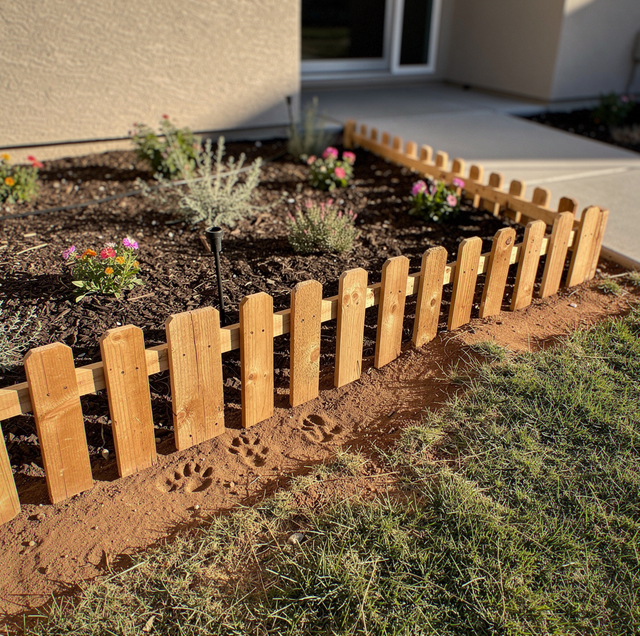
The bed along the front walk looked finished in April. Two rows of leaf lettuce, a run of drip tube, and a line of low cedar pickets around the whole thing. By June, the lettuce was chewed to the ribs, an emitter hung loose, and prints crossed the mulch and carried on out to the far side.
Your pickets are still straight and still doing what you put them there to do. They mark where your planting ends so nobody steps in it. Nothing about them was sized to stop what got in. Both kinds of garden fence go around a planted bed, and only one keeps something out. Which one you need follows what crossed your mulch, not how you want it to look.
What a Decorative Border Is Built to Do
A decorative garden fence aims to enhance curb appeal and define the garden area. The shapes that do that work are clean lines, ornamental detailing, and a low profile that frames the plants and the walkway without blocking the view across them. Every one of those choices concerns how the bed looks from outside it.
Habit does the work here, and force never enters into it. A person walking a path sees an edge and steps around it. A mower wheel stops at it. A hose dragged across the yard rides around the outside of the run instead of through the middle of the lettuce. None of that needs height, and a border that gains height stops doing the job it was there for: leaving the planting visible.
Low-profile runs do a second job unrelated to animals. They provide subtle boundary definition, separate one planting area from another, and guide movement through the surrounding space while keeping the yard open. A bed in the middle of a lawn, with three paths converging on it, needs that more than a barrier.
What Sinks Into the Soil and What Sits on Top of It?
The difference between the two fences is almost entirely below the mulch line. A decorative border stops at grade: the pickets begin where the soil begins, and the gap under the bottom rail runs the length of the bed. A protective enclosure closes that gap, and the whole build exists to close it. Against rabbits, the requirement is plain: a two-foot fence of chicken wire is enough when the bottom sits tight to the ground or is buried a few inches, and the mesh should be an inch or less so young rabbits cannot pass through it. Two inches of daylight under a two-foot fence gives back most of what the two feet bought.
Mesh size meets the second half of that requirement; it is a measurement, not a preference. One inch was not picked for looks. It is the opening a young rabbit cannot fit through, and a two-inch mesh on the same posts, at the same height, with the same buried bottom, keeps out the adults and passes the young ones straight into the lettuce.
The heavier build is a more substantial fence of welded wire, chain link, or hog wire. Those are ordinary fence materials worked at garden scale, and you reach for them for the way they hold their geometry.
What Sinks a Border Out of Line in a Watered Bed?
Bed soil is the loosest ground on the property, and it is kept that way on purpose. It gets turned, amended, and watered on a timer every day or two during the warm half of the year. A post in that material sits in a column that swells and shrinks under it on a cycle. A short decorative post, set shallow because it only holds up eighteen inches of picket, moves first: it leans toward the walk, the line goes wavy, and a run that looked square in April looks crooked by August.
A protective enclosure loads its posts differently. Mesh stretched between them pulls inward at every corner, and every end, and a skirt buried along the bottom holds the fabric down against anything pushing up beneath it. Those posts go deeper and take concrete, a real hole in the ground that is not all soil. Under the amended layer lies a hard caliche pan that a shovel will not break, and the depth of that layer varies across a single bed.
Striking a buried line while digging can injure whoever holds the shovel, so a fence crew waits for the utility locators to mark those lines before any post hole opens.
Height Follows the Job the Fence Was Given
Height on a garden fence follows purpose. Low-profile runs go in as decorative borders, while taller options are chosen where added protection or separation is the point. Height is the number most people start from, and the last one that should be fixed.
Two feet covers a rabbit, and on a taller build only the lower one and a half feet need one-inch wire mesh. So a four-foot chain link run around a vegetable bed does not need one-inch mesh throughout its height.
Where the Two Jobs Overlap, and Where They Do Not
The overlap is real, and it lives in the material. The bottom edge stays separate. Welded wire takes a powder coat. A chain link run sits behind a low ornamental rail. Custom layouts are drawn so that the side of the bed facing the house looks like a border, while the side facing the back fence stays close to the ground.
The heavier build also has its own uses: it keeps pets and children out of the garden and can trellis vine crops. A welded wire panel carrying pole beans does two jobs at once, and neither of them is available to a six-inch picket.
What does not overlap is the bottom. A border can be built tall and stay a border, because nothing about it was ever closed to the ground. An enclosure can be built low and stay an enclosure, because its bottom edge was. Height moves freely between the two. The bottom edge does not.
Reading Your Own Bed Before Anything Gets Ordered
The damage tells you which fence your bed is asking for, and it is specific. Leaves clipped at a clean angle, low down, with the stems left standing, means browsing from something small and close to the ground. Stems snapped and soil thrown means something bigger, or a dog. Prints that arrive at the bed and stop are a visitor. Prints that arrive, cross, and leave on the far side are a route, and a route keeps getting used until something closes it.
Two outcomes result from that walk. One bed gets a low run that frames the planting, holds the line against feet and mower wheels, and leaves the view straight through to the plants. The other gets an enclosure whose mesh is sized to the animal and whose bottom edge is closed to the ground, with the planting behind it. Neither is the better fence. They do different work, and the mulch in your bed has already picked one.
Frequently Asked Questions
Not if the run is laid out for what the planting turns into. Garden fences get positioned to leave adequate space for growth, and planning that ahead avoids crowding and shading problems later. Check what your fence will shade in the afternoon before you pick your side of the bed.
It discourages them, which is not the same as excluding them. A fence around your planted area reduces digging, trampling, and damage a pet causes to a bed it crosses. If your dog already knows the route across your lettuce, you want the buried bottom edge, not the low border.
The bottom follows the ground, not the top rail. Where your bed falls away, the mesh runs long and gets pinned down in the low spots, or a few inches get buried so the dips stay closed. One open dip under your fence is the whole gap, and whatever you fence out will find it.
Sometimes. A low ornamental run with pickets close together can take a wire skirt fastened to its inside face and pinned into the bed, closing the gap and leaving your view from your walk alone. Wide-spaced pickets or a rail-only design give that skirt nothing to fasten to, so what you have gets replaced.
Maintenance varies by material, and periodic inspections keep a run aligned and secure over time. That matters more on a garden fence than elsewhere because the ground under your posts moves with watering, and the posts are short to begin with. Walk your run once a season, push on every post, and check the bottom edge for soil washed up against it or mulch you piled there.
Yes. Planting a garden and installing a fence or mailbox both call for a utility locate first. The process is a request and then a wait: contact the local call-before-you-dig center, wait the required time for utilities to respond, and confirm every utility has responded before the first shovel goes into the ground. Locators then mark the approximate positions of buried lines in paint or flags.
Book a look at the bed you want fenced — a crew can walk the run with you, check what the posts have to go into, and lay out the border or enclosure the planting needs. Sereno Custom Fence & Gates serves Phoenix and the Valley. Call (602) 353-7385.
