
Is Your Leaning Fence a Footing Problem? How to Tell
Quick Answer: A fence leans when the post loses its anchoring in the ground, not because the panels give out. Push on the post: if the post rocks or pivots in the soil, the footing has failed, and the post needs to be reset or replaced. If the post stays firm and the material sags between posts, that is a panel repair.
A fence that has started to tilt is easy to spot and hard to ignore. What is less obvious is where the problem actually lives. Most people look at the panels or the wrought iron because that is the part that has moved, but the panels are rarely the reason a fence goes crooked. The lean almost always starts at the post, down in the ground, where the footing is supposed to hold everything upright.
Understanding that one point saves a lot of guessing. If you can figure out whether the post has lost its grip in the soil or whether the fence material itself has sagged, you know whether you are looking at a footing job or a much smaller repair. This article walks through why posts fail, how to check yours, and what a proper fix involves.
Why a Fence Leans in the First Place
A fence post works like a lever planted in the ground. Everything above the soil, the panels, the rails, the gate, presses sideways on that post, and the buried portion, plus its footing, is what resists the push. When the buried part stops resisting, the post tips, and the whole run tilts with it. So the useful question is not "why is the fence leaning" but "why has this post stopped holding."
Think of a post the way you would think of a beach umbrella. Push the pole deep into firm, packed sand, and it stands against a stiff breeze. Set it shallow in loose sand, and the first good gust lays it over. The umbrella fabric did not fail. The anchoring did. A fence post fails the same way, and for a handful of specific reasons.
One common reason is a post that was set too shallow. If the buried length does not reach below the zone where the soil shifts with moisture, the ground itself moves the post over time. Another is a post set without any concrete at all, just tamped dirt, which loosens with every wetting and drying cycle.
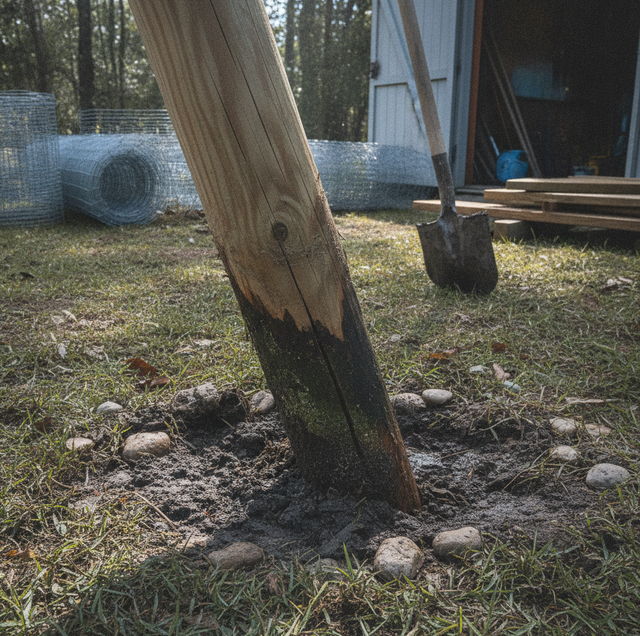
Then there is decay. A wood post tends to rot at the soil line, the exact band where wet earth meets open air. A steel post can rust through at or just below grade for a similar reason. In both cases, the post can look solid above the ground and be badly weakened right where it counts.
The footing itself can fail, too. A concrete collar can crack or get pushed upward when the soil around it swells and shrinks, which happens readily in expansive clay soils. Water that pools at the base speeds all of this along by softening the ground and feeding rot. And a solid fence, the kind with no gaps, catches wind like a sail, so its posts take a harder push than an open picket or wrought-iron design ever does.
How to Diagnose the Lean Yourself
You can narrow the problem down in a few minutes with your hands and your eyes. Start at the leaning section and work post by post.
First, grip the post and push it firmly back and forth. Pay attention to where the movement happens. If the post itself rocks, pivots, or wobbles at ground level, the anchoring has failed, and you are looking at a footing or post issue. If the post stays planted and the movement is in the material spanning between posts, the footing is fine, and you have a sag in the panel, rail, or hardware.
Next, look closely at the post right at the soil line. On a wood post, press a screwdriver or your thumb into the wood there. Soft, spongy, or crumbling wood means rot has taken hold, even if the post looks healthy a foot up. On a steel post, look for heavy rust, flaking, or a section that has thinned or opened up near the base.
Then inspect the concrete collar if there is one. Look for cracks running through it, a section that has lifted or tilted out of the ground, or a gap between the concrete and the post. Any of those means the footing has moved or broken and is no longer doing its job.
Finally, notice what the ground does around the base. Does water sit there after rain or irrigation? Has soil washed away and left the footing partly exposed? Both point to conditions that undermine a post over time, and both need to be addressed as part of any real fix.
Footing Problem or Panel Problem
Sorting the fence into one of two buckets tells you how big the job is.
A footing or post problem shows up as a post that moves in the ground. The panels attached to it may look fine. This is the category that needs digging: the post gets reset in a fresh footing or, if the post is compromised, replaced entirely. It is the more involved repair, but it is also the one that actually stops the lean.
A panel or rail problem shows up as a post that stays put while the material between posts droops, bows, or pulls loose. Here, the fix is usually hardware or a section repair: re-securing a rail, replacing sagging pickets, tightening or swapping a bracket. No digging, no concrete, and often a much quicker visit.
Getting this distinction right before anyone starts work matters because the two repairs share almost nothing. Resetting a footing on a fence that only has a loose rail wastes effort, and patching a panel on a fence with a failed footing leaves the real problem in place, so the lean comes right back.
How the Footing Is Actually Fixed
When the diagnosis lands on the footing, the goal is not just to stand the post back up. It is to correct the reason it fell over, so it stays upright.
If the post itself is still sound, it can often be dug out and reset. The old footing gets broken up and removed, the hole is deepened and widened so the post reaches below the soil-movement zone, and fresh concrete is poured around it. A good pour is crowned or sloped at the top so water runs away from the post rather than collecting against it, which is one of the small details that decides whether the repair lasts.
If the post is rotted at the base or rusted through, resetting it is a dead end. A failing post placed back in the ground simply fails again on its own timeline. In that case, the post is replaced, and the new one is set at the proper depth in a new footing.
Drainage and grading come into the same conversation. If water was pooling at the base or soil was eroding away, the ground around the fence line gets regraded so it sheds water. Skip that step, and even a perfect footing sits in the same wet conditions that ruined the last one.
Local conditions shape all of this. Dense clay soil swells and moves with moisture, storms drive short bursts of heavy wind and rain, and long dry stretches let the ground shrink and pull away from footings. None of these is a season you can plan around, since the pull works year-round: wind and swelling soil push in the storm months, shrinkage and dry-loosened dirt work at the post the rest of the year. A footing built with real depth and good drainage stands up to both.
Before Any Digging
If you or a contractor plan to dig, call 811 first to have underground utility lines marked. Fence footings sit at a depth where buried gas, water, and electric lines can run, and marking is free. This is a standard precaution on any post work, and it is worth the couple of days it takes to get lines located before a shovel goes in the ground.
Frequently Asked Questions
Look down the whole run and check which way things lean. If several posts tip in the same direction together, the cause is usually a soil or drainage problem along that line rather than any one footing. A single post out of plumb while its neighbors stand straight points to just that one footing. Pairing the tilt pattern with a quick soil-line check on the leaning post usually tells you which repair you are facing before anyone digs.
That band is where wet soil meets open air and oxygen, so the wood there stays damp and sits in the conditions decay organisms need most. Below the surface, the wood is wetter but starved of air, and above the surface it dries out, so the narrow zone right at the soil line gets the worst of both. That is why a post can look sound a foot up, and a foot down, yet be rotted through exactly where it enters the ground.
Deep enough to reach below the layer of soil that moves as it takes on and loses moisture, and deep enough to give the post enough buried length to resist tipping, often in the range of about a third of the post's total height. The concrete should also be sloped or crowned at the top so water sheds away from the post instead of settling against it. Depth and drainage together are what keep the post anchored.
There is often a middle option between resetting and full replacement. A wood post that is still sound above but rotted right at grade can be braced with a steel post-saver or anchor spur, driven into the ground alongside it and bolted on, which stiffens the post without pulling the whole panel apart. That path only works while the upper post has good wood left to bolt into. A post rotted through its length, or a steel post rusted through at the base, is past bracing and has to come out.
Yes. A solid block or panel fence acts like a sail and catches far more wind load than a picket fence or wrought-iron run that lets air pass through. Because more force reaches the posts, a solid fence needs its posts and footings sized and set stronger to resist the push, so an undersized footing shows up as a lean much sooner on a solid design than on an open one.
Two build details decide how well a post shrugs off standing water. Setting the post on a few inches of gravel below the concrete gives water a path to drain away from the base instead of sitting against it. Crowning and sloping the top of the footing sheds water off the surface in the same way. Both slow the wet-and-dry soil movement that gradually works a post loose, so a footing poured with a gravel base and a shed-off top holds far longer where drainage is poor.
Book a free on-site assessment before the next storm tests it — get a straight read on whether your footing needs resetting or replacing. Sereno Custom Fence & Gates serves Phoenix and the Valley. Call (602) 353-7385.
