
Fence Level or Follow the Slope: What the Fence Is For Decides
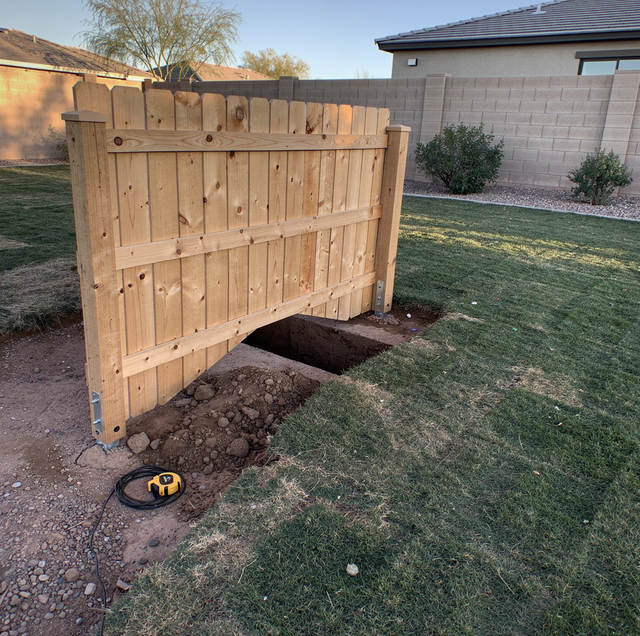
Pull a string line across a yard that drops toward the back corner, and the string stays dead level while the ground underneath it keeps falling away. That gap between the string and the dirt is the entire decision a fence installer has to make before the first post goes in the ground: does the fence follow the string, or does it follow the ground?
Which one is right depends on what the fence is for. A fence that has to hold a dog in the yard, or that borders a pool, needs the bottom to be closed against the ground at every point along the run and, following the grade, to close without anything added. A fence that marks a property line or frames a front yard can take a stepped look, and plenty of homeowners deliberately choose stepping for the way a run of level panels reads along a walk.
Two Ways to Set a Fence on a Sloped Run
There are exactly two answers, and contractors call them stepping and racking, or contouring. Stepping holds each fence panel level, exactly as it would sit on flat ground, then drops the whole panel down in a fixed increment at the next post, so the run descends the slope in a series of level sections, one drop at each post. Every top rail in a stepped run sits level on its own panel, and the run as a whole loses height in stages, because each panel sits a set distance lower than the one before it. Racking, or contouring, does the opposite: the top and bottom rails tilt to match the grade continuously from post to post, so the rail line follows the ground as it actually falls, without discrete drops. Individual pickets inside a racked panel typically stay plumb, vertical, even while the rails they're attached to tilt beneath them.
The Gap Stepping Leaves at the Bottom
Stepping solves the level-panel problem by creating a second one. Because each panel stays level while the ground beneath it keeps falling away, a triangular opening forms under the low end of every panel in the run, wide at the downhill post and closing to nothing at the uphill post. That opening isn't a flaw in the installation; it's simple geometry: a level top plate cannot touch a falling grade at more than one point along its length. On a gentle slope the gap might be an inch or two at its widest point. On a steeper run it can open enough for a small dog to walk through without ducking.
How wide it gets is arithmetic you can do before an estimate arrives. Take the total fall from one end of the run to the other, divide it by the number of panels, and the result is the drop at each post, which is also the height of the triangle at the low corner of every panel. Two feet of fall across six panels opens about four inches under each one. The same two feet across three long panels opens about eight.
What that opening does once the fence is standing depends on the job. Under a fence that marks a line, it collects leaves and blown trash. Under a fence holding a dog, there is a way out, and a small dog needs less clearance than most owners expect. Loose yard material travels through it too: mulch, gravel, and decomposed granite on the uphill side wash under the panels in heavy rain and pile up on the far side. The usual closure is a grade board, a wider horizontal board fitted under the panel at each step to fill the triangle. Because it sits against soil, a grade board is normally a rot-resistant or pressure-treated piece even on a fence built from something else, and installers often set it over a shallow band of gravel so water drains away from the board.
A stepped panel's bottom gap is widest at the downhill post, often wide enough for a small pet or a crawling child. Where the fence also serves as a pool barrier, confirm the required gap size with your local building department.
Racking has no equivalent gap, because the bottom rail tracks the grade the same way the top rail does, so nothing opens up underneath it as the ground falls away. The bottom of a racked fence keeps a steady distance off the dirt along the entire length of the run, which is why it's the default choice whenever the fence needs to contain something.
What Your Fence Material Already Decided
Whether racking is even available depends on how the fence arrives at the job site. A preassembled panel, the kind that ships as a finished rectangle of pickets already fixed inside two rails, racks through a bracket at the post connection, and that bracket has a built-in range: typically a few degrees of tilt before the rail binds against the post or the picket spacing at top and bottom stretches unevenly. Past that range, the panel has to be stepped whether the look is wanted or not. A stick-built fence, assembled board by board on site rather than shipped as finished panels, has no such limit: the rails get cut and set to follow whatever the ground does, and individual pickets get trimmed to a common line as they go. That's why a wood picket fence built on site can follow almost any grade, while a shipped vinyl or aluminum panel fence often can't follow a steep one at all. In practice, choosing the material chooses the method before the slope ever enters the conversation. Comparing materials on cost or upkeep is its own decision and a different one than this.
How far a preassembled panel will rack depends on the joint at each end and on how the pickets are attached to the rails. Ornamental aluminum and steel panels sold as rackable use a swivel bracket or a punched rail that lets each picket pivot where it passes through, so the rail can tilt while the pickets stay vertical, and manufacturers usually publish the range as inches of drop across the panel width, because inches of drop is what an installer can put a tape on at the site. A welded panel has no pivot anywhere in it, so forcing it to follow a grade tilts the pickets along with the rails and throws the whole panel out of square; those get stepped at any slope at all. Vinyl privacy panels are the tightest case of the three, because the rails seat into routed holes in the post. A hole cut for a level rail will accept a rail arriving at only a slight angle, so a vinyl fence on anything past a mild grade is usually stepped unless the maker offers angled routing or a bracket kit for the run.
How Each Method Looks When It's Finished
A racked fence reads as a single continuous line drawn along the ground, rising and falling with the yard. A stepped fence reads as a series of level drops, one at each post, with the run losing height in visible increments, each panel sitting a fixed distance below the one uphill of it. Each is simply a different look, suited to a different kind of run. Stepping is a deliberate choice on plenty of runs, particularly on a formal front-yard line where the fence is meant to read as a uniform architectural element, every top rail sitting on a true horizontal the eye can check against the house behind it. A picket fence stepped in even, deliberate drops along a front walk can look intentional and finished. On a backyard run where the fence exists mainly to be functional, racking usually wins because it closes the bottom gap without adding a separate piece.
Post Depth and Drainage on a Sloped Run
Post depth is measured from the finished grade at each individual post along the run. In a stepped fence, the height of each post above that grade changes as you move along a single step: the top of the panel stays level while the dirt beneath it keeps falling, so the post at the low end of a step stands taller out of the ground than the post at its high end. Post lengths get cut to suit each position along the run, and the buried portion is set from the grade at that post whatever the post beside it needed. In a racked fence, the top line follows the ground, so above-grade post height stays close to constant from one post to the next and only the depth measurement moves with the grade.
Panels on a falling grade pull downhill, and that pull collects at the bottom of the run, so the low-end terminal post is commonly set deeper or in a wider footing than the line posts uphill on the same fence.
Where a fence line crosses a swale, a natural low point where water collects and moves during rain, the bottom of the fence needs enough clearance to let that water pass instead of ponding against the posts and pickets. A racked fence with a continuous bottom rail can be set slightly higher off the ground at that one low point to allow the clearance. A stepped fence already has a gap there due to its geometry, which, at a drainage crossing, works in the fence's favor.
Walking Your Own Site Before You Decide
None of this requires guessing once the yard gets walked with the right questions in mind. The walk answers three things: how much the ground drops from one end of the run to the other and how abruptly it does it, whether the chosen material's hardware can rack that far, and whether the line crosses a swale. Those three settle what is physically available. What the fence is for settles which of the available options you want: a dog run or a poolside line needs the bottom closed, which points at racking or at stepping with a grade board fitted under every panel, while a property-line fence or a front-yard frame can carry either, and the choice there follows taste and whatever the material already wants to do. The total fall is worth measuring before anyone quotes the job. A string line pulled level from the high end and a tape dropped to the dirt at the low end give you that number, and it decides whether the material you had in mind can rack the run or has to step it.
Frequently Asked Questions
Yes. Chain-link fabric and its top rail are continuous rather than built as fixed rectangular sections, so the whole run can follow a rolling grade in one smooth line, as a racked wood or ornamental-iron fence does, without discrete drops at each post.
Almost always. A gate has to swing on its hinges without dragging, so it's hung level and plumb regardless of what the surrounding panels are doing, which means the ground under a gate on a slope typically gets its own small ramp or cut to meet the gate's bottom rail evenly.
Installers who step a fence on purpose, for the finished look on a formal run, often add a separate horizontal board or trim piece, sometimes called a grade board or kickboard, fitted under the panel at each drop to close the triangular opening without changing the level top line above it.
An installer sets each picket individually and trims its bottom edge to follow the ground directly beneath it, a technique sometimes called scribing, so the fence line traces the grade board by board instead of pivoting through a hinged bracket.
On a grade steeper than a single run can reasonably rack or step, installers sometimes break the fence into short terraced sections, each one its own level or racked segment tied into a low retaining piece or a change in elevation, rather than forcing one continuous line down the whole slope.
Yes, separately from any grade adjustment. Corner and gate posts carry more lateral load from the panels pulling on them or the gate swinging from them, so they're typically set deeper than line posts regardless of slope, with the grade-based depth adjustment applied on top of that standard depth.
Schedule a site walk — your grade gets looked at in person, and you hear which method actually fits it. Sereno Custom Fence & Gates serves Phoenix and the Valley. Call (602) 353-7385.
