
Why Your Fence Posts Loosen in Caliche Soil
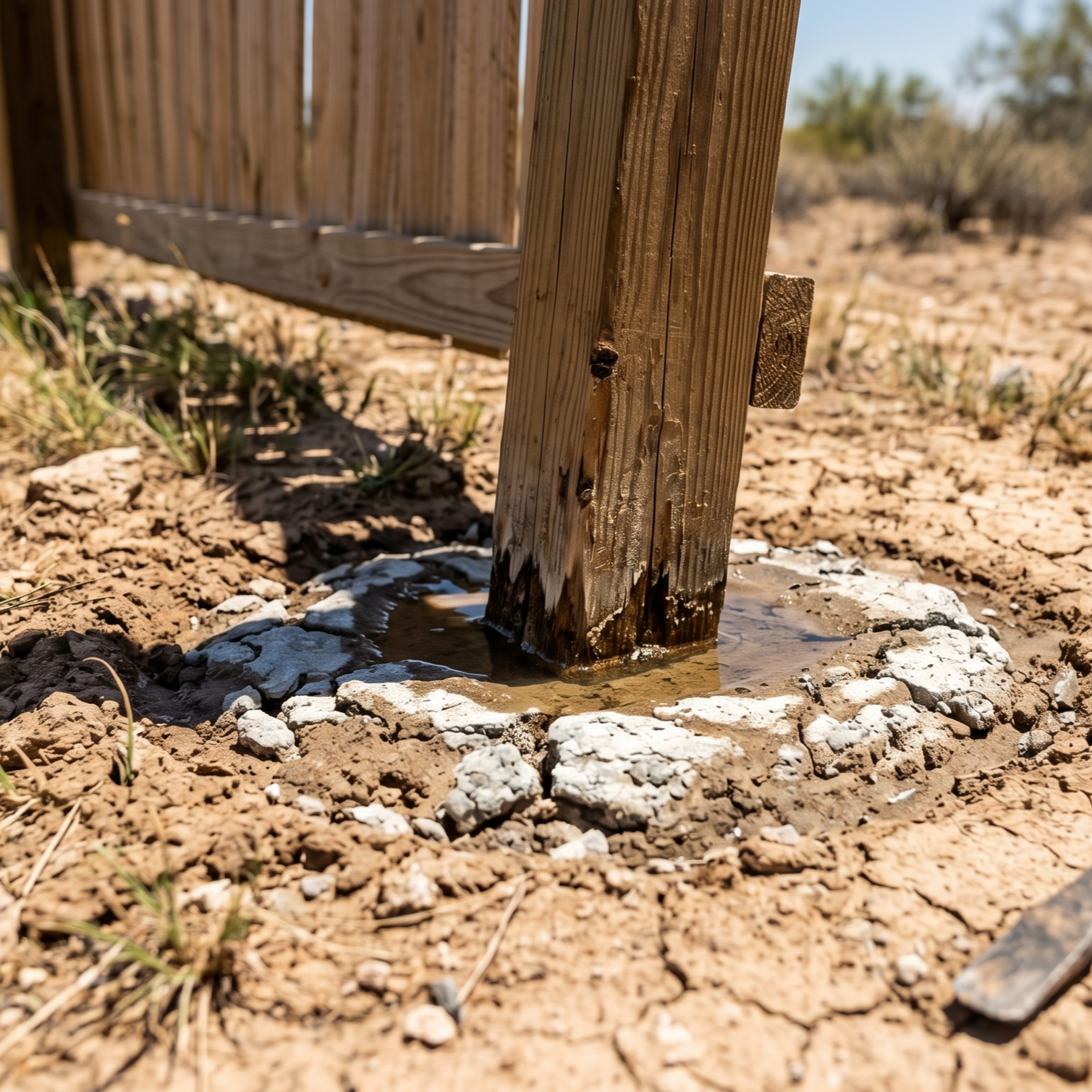
Quick Answer: Caliche is a cement-hard, calcium-carbonate layer in desert soil that barely drains. When a post hole bottoms out on it, water pools in the hole instead of soaking away — sitting against the post through every monsoon and dry spell. That trapped water rots wood, corrodes metal, and works the footing loose as the soil swells and shrinks. The fix is drainage: a gravel base, the right depth and width, and a concrete collar sloped to shed water.
You lean on the gate and feel it give. The post wobbles in the ground, the panel sags, and you know it wasn't like that a couple of summers ago. In most of the country, a loose fence post means rot or frost. Here in the Valley, the usual villain is the ground itself — a layer of caliche under your yard that handles water in exactly the wrong way for a fence. Understanding what it does explains both why posts fail and how to set one that won't.
What Caliche Actually Is
Caliche is a layer of soil where the particles have been cemented together by calcium carbonate — the same compound that makes up limestone and chalk. It forms over a long time as calcium dissolved in rainwater seeps down, combines with carbon dioxide in the soil, and hardens into a crust that can range from loose nodules to a solid, rock-like slab inches or even feet thick. It's common across southern Arizona soils, and if you've ever swung a digging bar and hit something that rang like concrete, you've met it.
That hardness is the first problem a fence installer runs into. But the way caliche behaves with water is what actually loosens posts down the road.
Why Caliche Loosens Posts
Caliche doesn't let water through. University extension research is blunt about it: water applied to soil simply can't move into or through a tight caliche layer, so it perches on top instead. Now, picture a post hole dug down to that layer. Rain and irrigation run into the hole, hit the caliche bottom, and have nowhere to go — the hole acts like a bucket, holding water against the post for days. Drainage is the whole game with a fence post, and caliche removes it.
From there, the damage follows the water. A wood post takes on more moisture than it can shed right at the soil line, and that's where decay starts — fence pros call it collar rot, the post failing exactly where it meets the ground while the top still looks fine. A metal post corrodes at the same waterline. And the footing itself works loose: the desert's hard, wet-then-bone-dry swing makes the surrounding soil expand and contract, monsoon storms saturate the trapped hole, and then the sun bakes it, and that constant movement opens a gap between concrete and post. Add the push of wind — a run of privacy fence catches air like a sail and drives that force straight down into the posts — and a footing that's already loose starts to lean.
How a Post Should Be Set in This Soil
Setting a post to last in caliche is all about giving water somewhere to go and getting the dimensions right. The method that holds up looks like this:
| Step | What it does |
|---|---|
| Dig the hole ~3x the post width | Room for a proper concrete collar around the post |
| Set depth at 1/3 to 1/2 of the above-ground height | A 6-foot fence needs at least ~2 feet in the ground |
| Add 4–6 inches of compacted gravel at the bottom | Gives trapped water a path to drain away from the post |
| Pour concrete, stopping a few inches below grade | Anchors the post without a water-catching basin at the top |
| Slope (crown) the concrete top away from the post | Sheds rain instead of letting it pool against the wood or steel |
There's a quick field test worth doing before you backfill: fill the empty hole with water and watch it. If it drops at least four inches in four hours, drainage is workable. If it just sits there, the caliche is sealing the bottom, and the fix is to break through that layer — punch a narrower hole through the caliche so water can finally escape below it. Skipping that step is how a brand-new post ends up loose in a few seasons.
Wood, Metal, and the Soil Line
Material choice changes how a post fails, not whether water is the enemy. Pressure-treated wood resists rot far better than untreated, but even treated posts decay at the soil line if they sit in standing water, so the gravel-and-crown drainage matters just as much for them. A galvanized iron or metal post trades rot for corrosion, and it holds up well in this soil when it's set with the same drainage in mind. Either way, the post that lasts is the one that isn't standing in a puddle underground.
Fixing a Post That's Already Loose
A post that wobbles isn't always a full replacement. If the post itself is sound and only the footing has loosened, it can often be reset, broken out, the hole corrected for drainage, and re-poured properly. If the wood is soft and dark at the base, or a metal post is rusted through at the line, the post has done its time and needs replacing. Either way, the repair only sticks if it solves the drainage that caused the failure; reset a post into the same water-trapping hole, and you'll be back leaning on a wobbly gate in a couple of summers. A proper fence repair starts by diagnosing why the post moved, not just re-pouring concrete around it.
Frequently Asked Questions
Caliche is a hardened layer of soil cemented by calcium carbonate, common in Arizona. It's tough to dig and, more importantly, it barely drains. A fence post hole dug down to caliche traps water against the post instead of letting it soak away, which over time rots wood, corrodes metal, and loosens the footing.
Plan on burying at least a third to a half of the post's above-ground height — roughly 2 feet for a standard 6-foot fence — in a hole about three times the post's width. Just as important, add a gravel base for drainage, because depth without drainage still leaves the post sitting in trapped water.
Use both. A 4-to-6-inch gravel base at the bottom of the hole gives water a path to drain, and concrete above it anchors the post. The key detail people miss is sloping the top of the concrete away from the post so rain sheds off instead of pooling against it. Concrete alone, with no drainage, can trap water like a cup.
Heavy monsoon rain saturates the poorly draining soil and post holes, then the intense sun bakes everything dry. That rapid swell-and-shrink cycle, repeated storm after storm, works the footing loose — especially if the hole had no gravel base and traps water. Wind during those same storms pushes on the fence and levers an already-loosened post into a lean.
Often, yes. If the post is structurally sound and only the footing failed, it can be reset with corrected drainage rather than replaced. If the base is rotted or corroded through, that post needs replacing, but the panels and the rest of the fence usually don't. The repair has to fix the drainage, or the same post will loosen again.
It corrodes them rather than rotting them, and it happens at the same place — the soil line, where a post sits in trapped water. Galvanized steel resists it well and is a strong choice in this soil, but it still benefits from a gravel base and a sloped concrete crown that keeps water moving away from the post.
The Soil Is the Real Problem — Set for It
A loose post in the Valley is rarely about a bad post and almost always about water that couldn't drain. Caliche turns a post hole into a bucket, and everything that follows — rot, corrosion, a leaning panel — traces back to that trapped water. Set posts with drainage built in, slope the concrete to shed rain, and break through the caliche when it won't let water pass, and a fence stands straight through monsoon after monsoon. Work against the soil instead of with it, and you'll be resetting posts on repeat.
Posts wobbling or a fence starting to lean? — Get the footings diagnosed and reset with drainage built for caliche, so the fix actually lasts. Sereno Custom Fence & Gates serves Phoenix and the Valley. Call (602) 353-7385.
