
Loose or Wobbly Handrail: What’s Failing at the Anchor Points
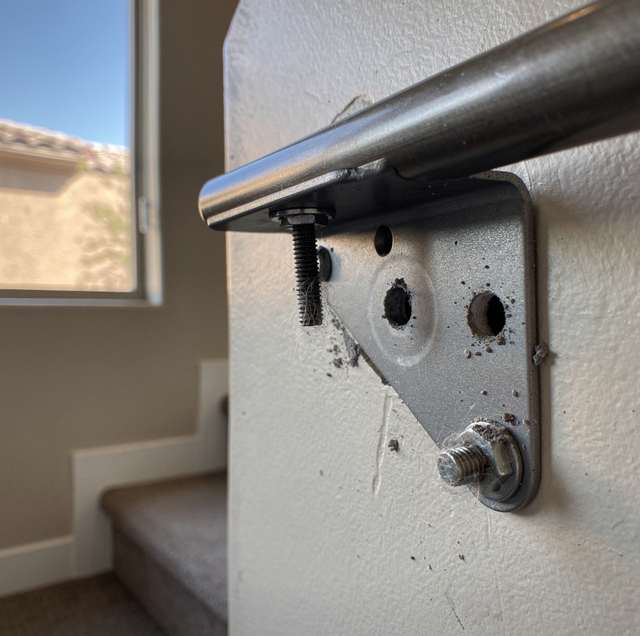
The rail at the top of your stairs moves about a quarter inch before it takes any weight. You push it sideways, and the bracket rocks against the wall, and a hairline crack runs out from the lower screw. Nothing has broken. The rail itself is straight, the welds hold, and the paint above the bracket is unmarked.
A handrail is not carrying anything most of the time. It waits, and then it takes a whole body at once. Everything you can see about yours may be fine while the joint you cannot see, the few inches where the bracket meets masonry or framing, has already given up most of what it was holding. So the fix starts underneath your bracket plate, not on it.
Where the Load Goes When a Hand Comes Down
Press down on a rail, and the fasteners under the bracket plate carry that load sideways across their shanks. Lean outward or catch yourself going down, and the plate tries to rotate off the wall: it pivots on its bottom edge, and the top fastener is pulled straight out of the material behind it. One anchor can fail four different ways in tension and three different ways in shear.
So the direction of your push matters more than how hard you push. A rail that stays put under downward weight and travels when you pull it toward you has lost its grip at the top fasteners, where tension does the damage. A rail that moves under any load at all has usually lost the whole plate. Both feel the same in your hand as they come down.
What Holds a Handrail to the Wall Behind It?
Four things in a row, and a failure in any one of them feels identical from where you stand. There is the rail, the bracket welded or bolted to it, the fastener through the bracket plate, and the base material that fastener is buried in. Handrails come in steel, iron, aluminum, and wood and run along stairways, ramps, balconies, and walkways, and every one reaches the building through that same short chain.
The top of the chain rarely fails first. A cracked weld and a bent plate are visible, so you can find them by looking. The bottom two hide. A fastener can back out inside a hole you cannot see, and the block or framing around it can crumble while the wall face stays flat and painted. A rail that has gone loose with nothing visible points down the chain rather than up it.
Pullout and Breakout Are Two Separate Kinds of Failure
Pullout and breakout are the two kinds. Pullout failure happens when a mechanical anchor pulls out of the drilled hole, leaving the base material otherwise largely intact. Breakout failure occurs when the base material ruptures, often producing a cone-shaped failure surface when anchors are set away from edges, or a spall when anchors are set near edges. One leaves a good hole and a spent anchor. The other leaves no wall.
Those two send the repair opposite ways. After a pullout, the hole is still a hole, and a crew can often reuse it with a different anchor. After a breakout, there is nothing left to grip, and the plate has to move to sound material. The edge clause matters, because brackets crowd the ends of a run, near a corner or a stair nose. An anchor near an edge takes a chip of the wall.
What the Bracket Was Set Into Changes the Whole Repair
Block is the case that catches people out: block is typically formed with large hollow cores, and block with a minimum of 75 percent solid cross-section still gets called solid block, even though it contains hollow cores. So a bracket bolted to a block wall may have every one of its fasteners in a face shell an inch or two thick with open air behind, or it may have one landing in a grouted core and the rest landing in nothing at all. The wall face over them is flat and uniform, so you get no help from looking at it. Two anchors in a four-hole plate can be carrying the whole rail.
Brick behaves two ways, and neither is friendly. Most brick is hard and brittle, whereas old red clay brick is often very soft and easily overdrilled. A hard brick chips at the mouth of the hole, and a soft one lets the bit wander, opening the hole wider than the anchor was sized for. The most common use of brick today is for building facades, curtain wall, or brick veneer, rather than for structural applications.
Wood carries its own version. A bracket on a wood-framed wall has to reach a stud or blocking behind the finish, and a screw that stops in drywall or a plaster coat holds for months and then does not. Locating that framing and adding blocking between studs where none lines up with the bracket is crew work behind an open wall, rather than a longer screw driven from the front.
Torque That Fades Early
Some of the give in a rail was there from the first week. Expansion anchors set to the required installation torque in concrete lose some of their pre-tension within several hours, and it is normal for those initial tension values to drop by 40 to 60 percent in the first few hours after installation.
That is ordinary behavior in a sound anchor: retorquing it back to its initial installation torque is not necessary. So the thing to watch is not whether your rail has any give at all, but whether the give is larger this month than last. A fixed small movement and a growing one look alike on any one day you check.
Drilling a Fresh Hole Beside the Abandoned One
The obvious repair is to shift over an inch and drill again. As a rule, anchors should not be installed closer than two times the drilled hole diameter away from an abandoned hole, and anchors more than two inches away from an abandoned hole do not require any reduction in capacity.
A bracket plate will not cooperate with that. Its holes are punched at fixed centers, so shifting one anchor an inch means the plate no longer lines up on the others. What happens is that the whole plate moves, instead of the hole, and the old holes get filled behind it. On a short flight with brackets already crowded against a corner, that means moving where the rail lands.
The Order a Crew Works a Loose Rail In
Nothing gets diagnosed while the rail is still bolted up. The plate comes off first, and only then can anyone see whether the hole is clean and round, whether the anchor came out with threads full of dust, or whether the back of the plate is bedded in crumbled block. That look decides the anchor type.
Then the base material gets tested away from the old holes, because a wall that gave up one anchor often has more of the same behind it. New anchors go in, the plate is drawn down, and the rail is loaded by hand along its whole length before anyone trusts it on a stair.
A rail that shifts under your hand will not catch a fall, so use the opposite wall and have a fence and gate crew pull the brackets and re-anchor it.
Frequently Asked Questions
Yes. Expansion anchors shed much of their installation tension in the first hours, so some of the give you feel was there from the start. Retorquing them is not necessary. What you want is a memory of what you felt in your hand last month.
It usually means the base material is failing, not the anchor. Breakout near an edge shows up as a spall or chip, not a clean cone, and a bracket close to a corner or a block end sits at that edge. The crack you see is the evidence, not the harm. What has changed is that the rail under your hand can no longer catch you.
It can. An aluminum bracket bolted to a steel anchor puts two different metals in contact, and in galvanic corrosion, the more anodic one corrodes preferentially once water provides a path for the ions. On a rail your irrigation reaches, you want that pairing named before it goes up on your wall.
The hole is worn past the size the anchor fits, and drilling beside it carries a spacing figure: new anchors need to sit twice the drilled hole diameter from an abandoned one, and two inches clear for full capacity. Your bracket plate rarely gives you that inch, so the plate moves, and your old holes get filled.
The mechanism is the same; the consequence is not. On a stair, you are already moving downward when you reach for your rail, so one that gives at that moment adds a flight of steps to the fall it was there to stop. A stair rail with new movement goes ahead of every rail you own.
No. It is common to see some corrosion in outdoor applications, and even stainless steel can corrode; some corrosion by itself does not mean load capacity has been affected or that failure is imminent. If significant corrosion is apparent or suspected, the fixtures, fasteners, and connectors should be inspected by a qualified engineer or inspector. So if you have not felt your rail move, the next move is to watch it. If it gives under your hand, the next move is a crew.
Book a look at a rail that has started to move before the next person leans on it — a crew can pull the brackets, find what the anchors were set into, and re-anchor the run into material that will hold it. Sereno Custom Fence & Gates serves Phoenix and the Valley. Call (602) 353-7385.
