
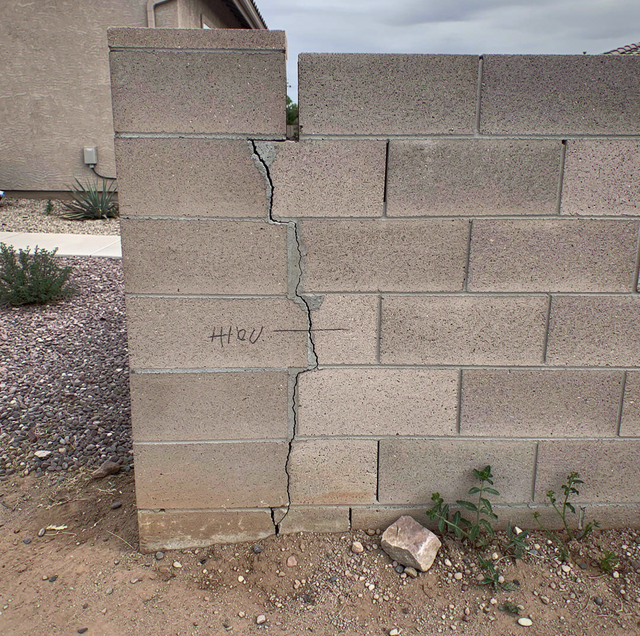
A block wall fence is a rigid structure: courses of concrete block bonded with mortar and set on a continuous footing. It cannot flex, so when the ground beneath it shifts, water collects at its base, or when a load bears on one spot, the strain manifests as a crack. Mortar is the weaker material, so a crack can follow the joints, and a larger strain can split a block. That is why the pattern of a crack says more than its length. A short crack that runs diagonally, widens at one end, or has a wall out of plumb can matter more than a long, fine line.
Reading the pattern gives you a first triage: the crack is monitored, repaired once its cause is addressed, or the wall is assessed before anyone touches it. Each crack pattern carries its own meaning and its own call:
| Crack pattern | What it indicates | Call |
|---|---|---|
| Hairline in the mortar or stucco that is not growing | Drying shrinkage after the wall was built, or slight soil movement that has stopped | Watch |
| Stair-step crack along the mortar joints | One part of the wall has settled or lifted relative to the part beside it | Repair once the cause is found |
| Vertical crack wider at the top or the bottom | Bending over a high spot, sagging over a low one, or shrinkage | Repair, or assess if it is growing |
| Horizontal crack with the wall bowing or leaning | The wall is rotating or being pushed sideways at that joint | Assess before anyone touches it |
| Crack at a gate post, pilaster or where two walls meet | A concentrated load, or two parts of the wall moving separately | Repair with the load or connection corrected |
| Cracking with white mineral staining or damp at the base | Water moving into and through the wall from wet soil or a spray source | Repair with the water source dealt with |
How Soil and the Footing Move a Wall
A wall that settles evenly along its entire length can drop slightly without cracking because every block moves together. The damage comes from differences: one stretch of footing sinks, lifts, or softens while the stretch beside it holds. Soil that swells and shrinks with its moisture is one cause. Others include a footing over uneven fill, a trench dug close to the wall, a leaking line, and a heavy load on one section.
Masonry is strong when squeezed and weak when stretched or bent. When one section drops, the wall above it has to span the gap, and the stretched side of that span opens. The crack forms where the tension is greatest, so its direction and taper indicate the direction the wall is being pulled.
Steel inside the wall changes what happens next. Where a reinforcing bar sits in grouted cells, it holds the pieces together across the break, so a crack can stay fine and stable. In an unreinforced wall, only mortar crosses the crack, and once it opens, the sections on either side move as separate pieces. Nothing on the outside shows which kind of wall you have.
Stair-Step and Vertical Cracks and What Their Shape Shows
A stair-step crack climbs the wall in a staircase, following a bed joint for the length of a block, then a head joint up to the next course. It takes that route because the mortar gives way before the block does, and the shape indicates that part of the wall has moved down or up relative to its neighbor. The next question is whether the two sides still line up. If the courses on one side now sit lower than the same courses on the other, or one face stands proud of the other, the wall has shifted across the crack, beyond a simple separation along it.
A vertical crack reads by its taper. Wider at the top can mean the wall is bending over a high point, with the ends dropping or the middle rising, or shrinkage in a wall held at its base; wider at the bottom can mean the wall is sagging over a low spot beneath the crack. A vertical crack of even width, with no offset between its faces, can come from block and mortar shrinking slightly as they dried after construction.
Where a crack leaves the mortar and cuts through the face of a block, the strain was large or concentrated enough to break the unit. That moves it out of the cosmetic column.
A pencil mark across each end of a crack, with the date written beside it, turns an impression into a record. A crack that later runs past its marks is still moving; one that stays inside them has held.
Horizontal Cracks and Bowing Are the Serious Pattern
A freestanding block wall stays upright because of its weight, its footing, and any steel tying the courses to that footing. A horizontal crack along a bed joint is a hinge line: the wall above it can rotate about it. When the face above the crack bows outward, or the top no longer sits over the base, the wall is already turning on that hinge.
Sighting along the top of the wall from one end, standing clear of it, shows a bow or a lean as a line that is no longer straight. Sideways pressure is one cause, and it can come from soil. A wall built as a fence is freestanding; once the ground is raised against one side by a backfilled planter bed, regrading or a creeping slope, the wall is holding back soil it was not built to retain, and water trapped in that soil adds to the push.
A leaning, bowing, or displaced section stays off-limits until it has been assessed. Nobody climbs it or sets a ladder against it; no gate is hung from it; nothing is stacked on or against it; and children and pets are kept away from both faces. A cracked block is not pulled out, and the footing of a leaning wall is not dug around, because either can release a section that is already unstable. A wall shared with a neighbor, or one holding back soil, is assessed before anyone on either side touches it.
A bowing section can topple onto a child, a pet, or anyone leaning on it, and removing a single cracked block can release the courses above; a block wall repair crew braces the section before any block is removed.
Water at the Base: Irrigation and Drainage Against the Wall
Soil that stays wet along one stretch while the next stays dry does not support the wall evenly, and that uneven support can produce stair-step and vertical cracks. The sources are ordinary: sprinkler heads aimed at the wall, drip emitters or a lawn run right to the base, a downspout discharging against the wall, and a grade that slopes toward it so water pools along the footing.
Water soaking into block carries dissolved salts, and when it evaporates at the face it leaves them as a white, powdery bloom. A white band along the base shows water wicking up from wet soil; staining concentrated along one crack indicates water entering through it. Where salts crystallize just under the surface, they can push the face of the block off in flakes, called spalling.
Salt bloom returns while water keeps moving through the wall, so the lasting repair starts upstream, with heads turned away, emitters moved back from the footing, runoff carried off, and soil graded to drain away from the wall line.
Stress Points at Gates, Pilasters and Added Loads
A gate hung from a masonry pilaster cantilevers its weight out from the hinges. Every swing and slam loads the pilaster sideways at the hinge anchors. Cracks show up around those anchors, at the pilaster base, or where it meets the wall. A pilaster crack and a sagging, dragging gate can share one cause, so they belong to the same repair.
Where two walls meet, build history matters. A corner laid up as one piece shares one footing and moves as one. A wall added later and butted against an older one sits on its own footing, and the joint between them can open as a straight vertical line. A crack that wanders from that joint diagonally into either wall shows that wall moving on its own.
Anything anchored to or stacked on a wall that it was not built to carry puts a point load into the courses: a shade structure bolted to the face, heavy planters along the cap, shelving hung from the block. The crack forms near the anchors or under the load, and the fix addresses both the load and the masonry.
How Repair Is Decided
The order is cause first, crack second, so the decision starts with why the wall cracked: water at the base, a load, a footing that has moved, or shrinkage that has already run its course.
Repointing: Cracked or loose mortar is raked out and replaced with fresh mortar, tooled to match the existing joint profile and color. This suits stable cracks that stay in the mortar.
Replacing damaged block: Cracked, broken, or spalled units are cut out, and new block is set in mortar, grouted where the cells carry steel. The stucco, paint, or textured face is then matched across the repair.
Stabilizing: The force behind the crack is corrected by redirecting water, removing a load, or transferring a gate's weight to a support designed to carry it. On some walls, steel is set into the joints or cells across the crack to tie the two sides together.
Rebuilding a section: A stretch that has rotated or bowed out of plumb is taken down to sound wall and relaid on a footing that can carry it. Pushing a leaning section back into line does not restore the bond in its broken joints.
One wall may need two of these: repointing along hairline joints and rebuilding a section where one end has turned.
Frequently Asked Questions
Not on a crack that is still moving. A rigid mortar or cement patch set into an active crack can crack again along the same line, and a flexible sealant that stays intact can hide further movement until the wall shows it another way. A patch holds on a crack that has stopped.
Yes. A crack that appears at the same spot on both faces runs through the full thickness of the wall. A crack visible on one face only may sit in the stucco or paint coat, or in just one face shell of the block, since a hollow block is two face shells joined by thin webs with open cells between them.
They can. A root growing beneath a footing thickens as the tree grows, lifting the section above it, and the wall cracks over that raised spot. Cutting a large root to relieve the wall can destabilize or kill the tree, so root work near a wall is weighed together with the masonry repair.
Not by itself. The cap course sits on the top of the wall in a bed of mortar, and that bed joint is open to sun and water from above. Once it cracks, water can get down into the hollow cells beneath, and a loose cap can slide off if someone leans on it. Resetting the cap in fresh mortar is a small repair in itself, unless the wall below it is moving.
The struck blocks break, and the shock can also crack mortar joints some distance from the point of impact or shift the wall on its footing. The damaged units are cut out and relaid, and the run on either side of the strike is checked for movement and for cracks that did not exist before.
It may be a control joint, a deliberate vertical break through the full height of the wall that lets the block shrink without cracking elsewhere. A control joint is clean and straight, filled with a flexible sealant, while the other joints hold mortar, and it can be repeated along a long wall. A crack that wanders away from that line is a separate issue.
Hire a crew for block wall repair — crack repair, replacement of damaged or missing block, and work on leaning or bowing sections. Sereno Custom Fence & Gates serves Phoenix and the Valley. Call (602) 353-7385.