
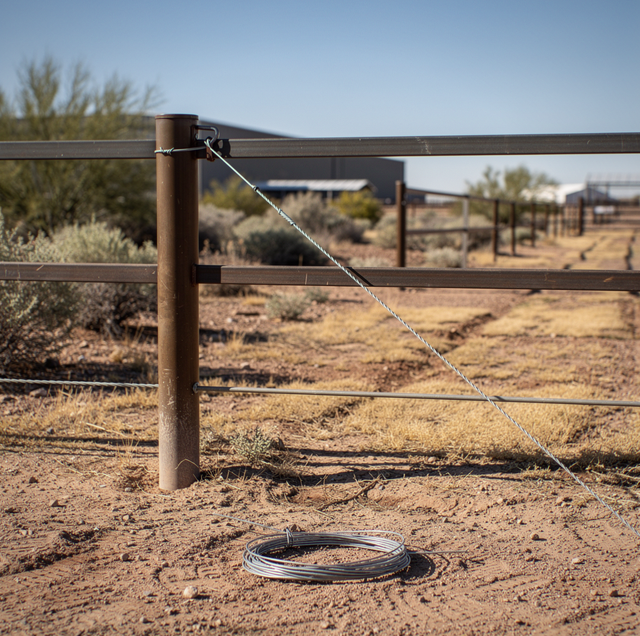
Every strand in a stretched wire fence pulls in one direction: toward the two ends of the run. Line posts spaced along the way hold the wire up and keep it separated, but they are not built to resist that pull the way a corner is. The pull lands on the posts and bracing at each corner, end, and gate opening, not on the line posts between them, which is why those points are built heavier and reinforced with a brace. When wire in the middle of a run goes slack, the wire itself is one place to look, but a corner or end assembly that has given ground under that pull is another cause, among others, and the one that drops tension across every strand tied to it once it moves.
A braced corner is built from a handful of parts, each with its own job and its own way of failing.
| Part | Job | What Failure Looks Like |
|---|---|---|
| Corner or end post | Anchors the assembly and carries the wire's pull down into the ground | Leaning into the run, pulled out of plumb by the wire |
| Brace post | Sits in line with the corner post and takes the diagonal wire's counter-pull | Leaning out of plumb, base working loose in the ground |
| Horizontal brace rail | Spans between the two posts and holds them apart under a steady push | Popped out of its notch or pin, split or bowed along its length |
| Diagonal brace wire and twist stick | Ties the brace post and corner post into one assembly and is drawn tight by twisting | Loose or sagging, or a twist stick backed partway out |
| Line posts | Hold the wire's height and spacing along the open run | Leaning or loose without dropping tension in the wire itself |
| Wire strands and their ties | Carry the tension from corner to corner and stay fixed to each post along the way | Sagging or loose ties somewhere along the run |
How a Brace Turns a Sideways Pull Into a Push the Ground Can Resist
A corner post standing alone against a tensioned wire is being pulled sideways at the top, and a single post fighting that pull with nothing but the ground around it can lean over time. An H-brace ties it to a second post set in line with the fence. The horizontal rail between their tops passes the wire's pull across to the brace post, and the diagonal wire keeps the pair from rotating together, so the pull is carried by two posts bearing on the ground instead of one.
The diagonal wire ties the two posts together so they move as a single assembly rather than two separate posts standing near each other. Twisting that wire tight with a twist stick removes any looseness from the connection before the fence wire ever goes up, so the brace is already carrying its own tension the moment it is finished, not just once the fence pulls on it.
Stretched fence wire stores tension, and a strand that lets go can whip back hard enough to cut skin. A crew stays clear of a wire's path whenever tension is added or released, never re-tensioning a loaded strand by hand.
Until a failed corner is rebuilt, nobody cuts or loosens a tight strand or climbs on the brace to check it, and anyone near the wire wears gloves and eye protection.
Single and Double H-Braces, and Where Else a Run Needs One
A corner or end is braced with either a single H-brace, a single brace post and rail in line with the run, or a double H-brace with two spans in line; a corner where two runs meet is braced along each run. Each brace resists the pull of the run it is set in, and a run pulling across it is held by a brace of its own.
Corners and plain ends are not the only points that carry a concentrated pull. A gate opening built into a run puts the same kind of load on its posts, and a long straight stretch of wire, with no corner to interrupt it, can still need a brace partway down its length to keep the whole run from working on a single distant end post. A change in grade, where the fence line angles up or down instead of running level, turns part of the wire's pull sideways as well as lengthwise, and that sideways component is carried the same way a corner's pull is, by a braced assembly rather than a plain line post.
Reading Slack Back to Its Source
The pattern of the slack is the first clue. Wire that has gone slack evenly along a whole stretch sends the first check to the corners holding that stretch, since a corner giving ground releases tension across every strand tied to it at once, though wire that has stretched over time can loosen the same way. A single strand sagging on its own, with the wire above and below it still tight, comes from something local to that one strand.
Once the search narrows to a corner, work through the assembly in order, by eye, from outside the wire's path. Check the corner post for plumb first, then the brace post, then whether the horizontal rail is still seated in its notch or pin, then the diagonal wire for tension. A post that still stands plumb but has a loose or sagging diagonal wire is an assembly that lost its bracing without the post itself having moved yet, and it is worth fixing before it does.
Why Re-Stretching Wire on a Corner That Has Moved Does Not Hold
Pulling the wire tighter without addressing the corner adds load to a post and brace that have already shown they cannot hold the tension they are already under. The assembly gives ground again under the added load. Re-stretching only holds where the slack came from somewhere other than the corner, such as a strand that has stretched on its own or a tie that slipped, and the corner and its brace are still plumb and tight.
Rebuilding a Corner
Once a corner is confirmed as the source, the wire on that run is released from tension before any work starts on the posts. A corner post that has only leaned can be reset in place; one that has rotted, rusted through, or snapped at grade is replaced instead. The brace post gets the same check, and the horizontal rail is reseated or replaced if it has popped loose or split. The diagonal wire is retwisted tightly with a fresh twist stick once the posts are set, so the assembly carries its own load again before the fence wire is restretched across it and tied back to each post along the run.
Frequently Asked Questions
A double H-brace adds a second span beyond the first, a third post in line with its own rail and diagonal wire, so the run's pull is shared across three posts instead of two. It goes in where one run's pull is heavy for a single span, such as a long, tightly stretched run, and the added span sits in line with that same run, not on the far side of the corner.
From the top of the brace post down to the base of the corner post. Run the other way; it lets the pair tip toward the fence under the wire's pull instead of holding it, and a brace set in the middle of a run, pulled from both sides, carries a diagonal in each direction.
The twist stick used to tighten it stays in place afterward, jammed against the post or the wire so the wire's own tendency to unwind has nothing to turn against. If that stick is pulled free, the twist can work loose gradually under the wire's own stored tension, even with nothing else disturbing the corner.
Yes. Each gate post ends the run on its side of the opening, so it carries the same steady pull an end post takes from the wire, plus the swinging weight of the gate every time it moves, and it is braced back into its own run the way an end post is.
Not on the run tied to that corner. Animals pushing on or reaching through slack wire can work it loose and tangle in it, and a leaning corner can let go under the extra load, so that run stays closed off until the corner is rebuilt.
Depth adds resistance, but a single post has only the soil on one face to push against, and under a full run's steady pull, it can rotate in the ground and lean over time. A brace adds a second post and a second patch of ground, so the pull is split between them.
Contract ranch fence and barbed wire corner rebuilding — corner and end posts, H-brace assemblies, and wire restretching and ties. Sereno Custom Fence & Gates serves Phoenix and the Valley. Call (602) 353-7385.